Perplexity Releases pplx-embed-v2-context-9b-preview: A Contextual Embedding Model That Retrieves Answers and Their Supporting Evidence
Perplexity Research and turbopuffer have released pplx-embed-v2-context-9b-preview, a contextual embedding model for RAG pipelines. Each chunk is embedded with the full document in view. The real change is the training signal. The model learns to retrieve the answer along with the context needed to verify it, not one ‘gold passage.’ P Is it deployable? Yes, as a self-hosted preview. Weights are on Hugging Face under the MIT license. Loading requires transformers>=5.4.0 with trust
Get smart on it
A contextual embedding model has been released for RAG (retrieval-augmented generation) pipelines, which are systems that retrieve relevant information from documents to support AI responses. Traditional approaches train these systems to identify a single best chunk of text per query, but this misses important context needed to verify answers, such as definitions or background information stated elsewhere in a document. The new model uses a teacher model that scores all tokens in a document and trains the system to retrieve both answers and their supporting evidence together, rather than treating all non-answer chunks as irrelevant. The model is available as open-source weights under an MIT license for self-hosted deployment, though it is not yet available through an API.
Related news
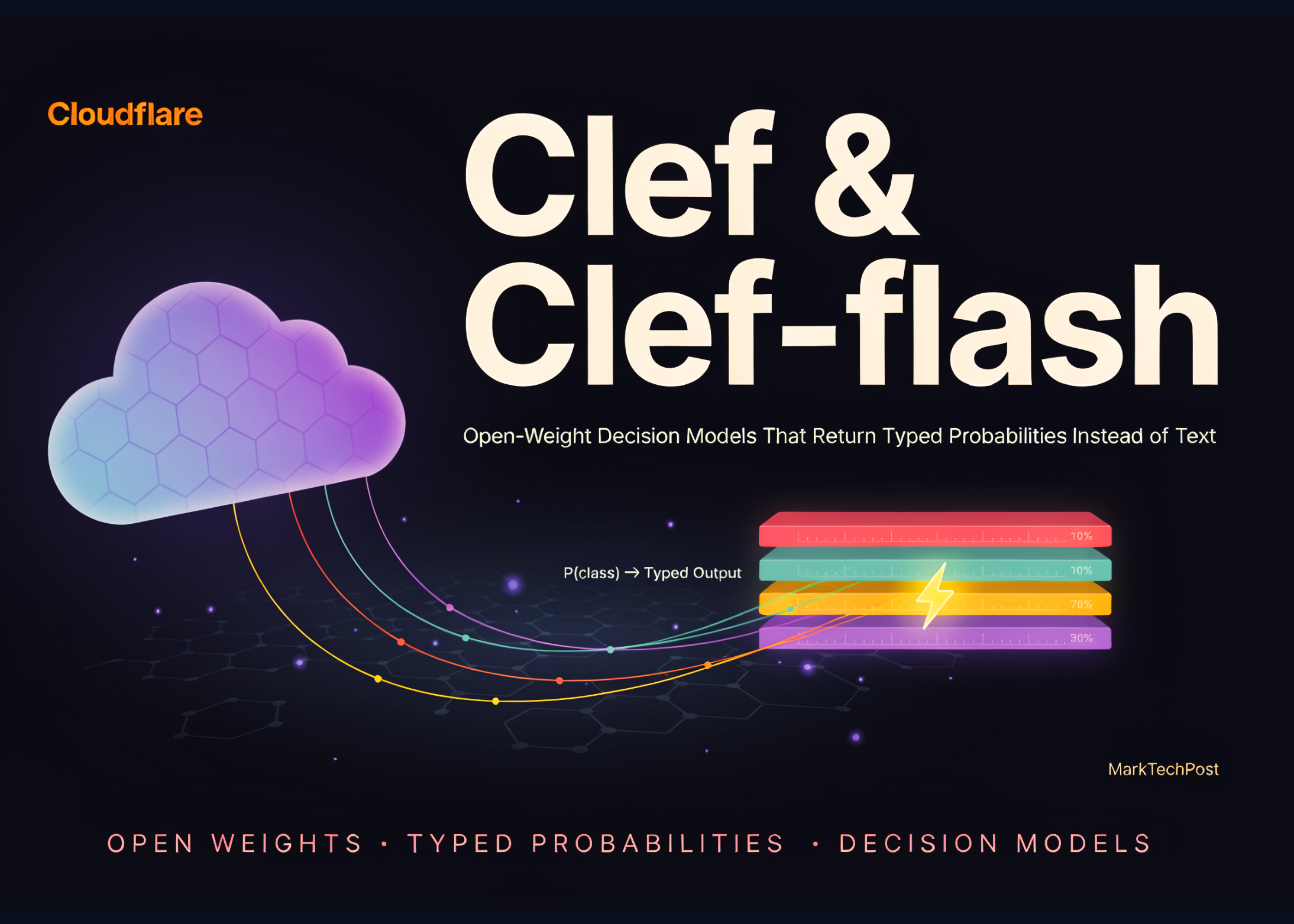
Cloudflare Releases Clef and Clef-flash: Open-Weight Decision Models That Return Typed Probabilities Instead of Text
Cloudflare has released Clef and Clef-flash, the first models trained by its Workers AI team. They are decision models, not chatbots. Each reads an input state and a schema of typed questions. It returns a probability for every allowed answer, with no free-form text. Both are open-weight under Apache 2.0 and compatible with TypeSafe AI’s Jev API. Is it deployable? Yes, Both models run today on Workers AI, and the weights are on Hugging Face for self-hosting. What a Decision Model Do
A Coding Guide to Google Research’s Kauldron: Configs That Are Plain Data, Components Wired by String, and a JAX Trainer You Can Read End to End
In this tutorial, we implement Kauldron, the JAX training library from Google Research that describes itself as optimized for research velocity and modularity, and we take those two words literally by testing what they actually buy us. We install it, then spend the first half of the notebook on the three mechanisms that make Kauldron different from a stack of Flax and Optax: konfig, which turns an experiment into a tree of plain dictionaries that round-trip through JSON; kontext, which wires co