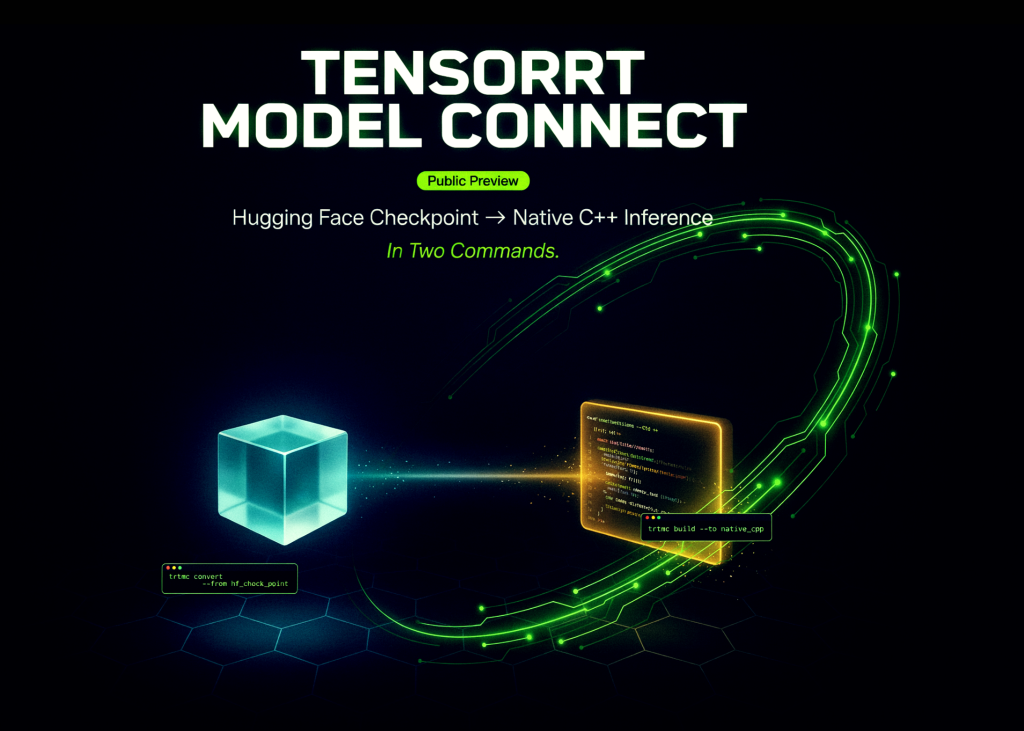
NVIDIA Releases TensorRT Model Connect in Public Preview: Hugging Face Checkpoint to Native C++ Inference in Two Commands
NVIDIA has released TensorRT Model Connect (TRTMC) in public preview, an open-source project that takes a supported Hugging Face or local checkpoint to end-to-end TensorRT inference in two commands. There is no intermediate ONNX export step. The build produces a versioned .bundle artifact that runs through native C++ task APIs, so inference can execute in a C++ service, embedded application, or robotics stack without PyTorch in the runtime path. The project is Apache-2.0 licensed and ships as a
How it resolved
Will the NVIDIA TensorRT Model Connect GitHub repo reach 1,000 stars by August 26?
Resolved NoResolved by Aug 26, 2026
Authoritative Metric: GitHub repository NVIDIA/TensorRT-Model-Connect — stargazers_count (total stars): 170. The resolution date is 2026-08-26, and the current star count of 170 is far below the required threshold of 1,000 stars.
Get smart on it
NVIDIA released TensorRT Model Connect, an open-source tool that converts machine learning models from a popular repository into optimized C++ code ready to run on devices in just two commands, without requiring intermediate conversion steps. The tool matters because it allows inference to run directly in C++ applications without needing Python in the runtime environment, making it suitable for robotics, autonomous machines, medical devices, and other systems where inference must be embedded directly in compiled software. The conventional approach requires multiple conversion stages between different formats, which can introduce compatibility issues and require repeated work for each model, whereas this tool aims to streamline that process with a single versioned package called a bundle that serves as the handoff point between the Python build phase and the C++ runtime.
Related news

Decision AI Models Explained: TypeSafe Jev vs Fastino GLiDE, GLiNER2.5-Decide and Open-Source Competitors
What are Decision AI Models? Decision AI models are a new class of model that returns a decision, not a paragraph. You send text with typed questions. The model returns choices, scores or yes/no probabilities your code can branch on directly. The category went mainstream when TypeSafe AI launched Jev after 2 years in stealth. TypeSafe calls it a ‘System One model,’ after Daniel Kahneman’s fast, intuitive System 1 thinking. Within 3 weeks, Fastino Labs shipped 2 rival
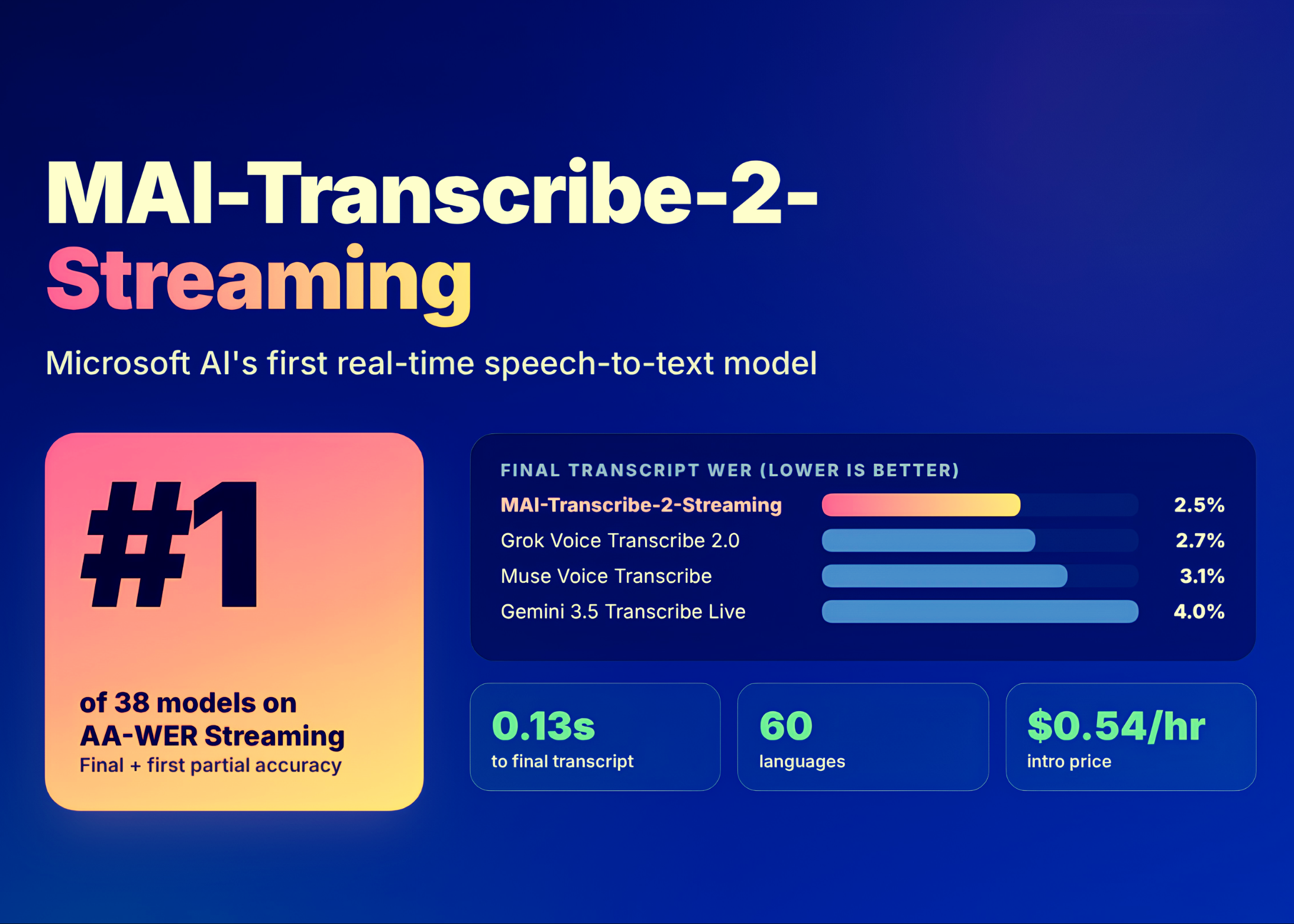
Microsoft AI Releases MAI-Transcribe-2-Streaming: #1 Real-Time Speech-to-Text Model on Artificial Analysis
Microsoft AI has released MAI-Transcribe-2-Streaming, its first streaming speech-to-text (STT) model. It launched on October 1, 2026, alongside 2 text-to-speech models, MAI-Voice-2.1 and MAI-Voice-2.1-Flash. Artificial Analysis ranks it #1 of 38 models for final and first partial transcript accuracy. The model targets voice agents, live captions and dictation, where latency decides the experience. What Microsoft Shipped MAI-Transcribe-2-Streaming is the real-time sibling of the batch MAI-