Multi-Vector (Late Interaction) Embedding Models with Sentence Transformers
These models improve search accuracy by capturing multiple semantic meanings per word, helping systems better match user intent with relevant results.
Get smart on it
Sentence Transformers version 6.0 introduces a new model type called MultiVectorEncoder for multi-vector embedding models, which keep one vector per token instead of compressing entire texts into a single vector. Multi-vector models defer the interaction between query and document until scoring time using the MaxSim operator, which compares every query token against every document token to find the best matches. This approach preserves token-level matching information and performs better on queries requiring specific pieces of documents or multiple requirements at once, particularly on out-of-domain data, but the tradeoff is a substantially larger index size since one vector per token generates many more vectors than traditional single-vector models.
Related news

AWS Strands Labs Releases Strands Decider 2B: An Open Source Decision Model That Picks Options in About 115 ms
AWS Strands Labs releases Strands Decider 2B, an open source decision model. It does not generate text. It reads a state and typed questions, then returns a choice, a yes/no probability, or a score with a calibrated confidence. The model has 1.9 billion parameters and runs locally on a CPU, a consumer GPU, or an Apple silicon Mac. Is it deployable? Yes, for local and self-hosted use. Weights are on Hugging Face under Apache-2.0, and pip install strands-decider gives a CLI and an HTTP server.
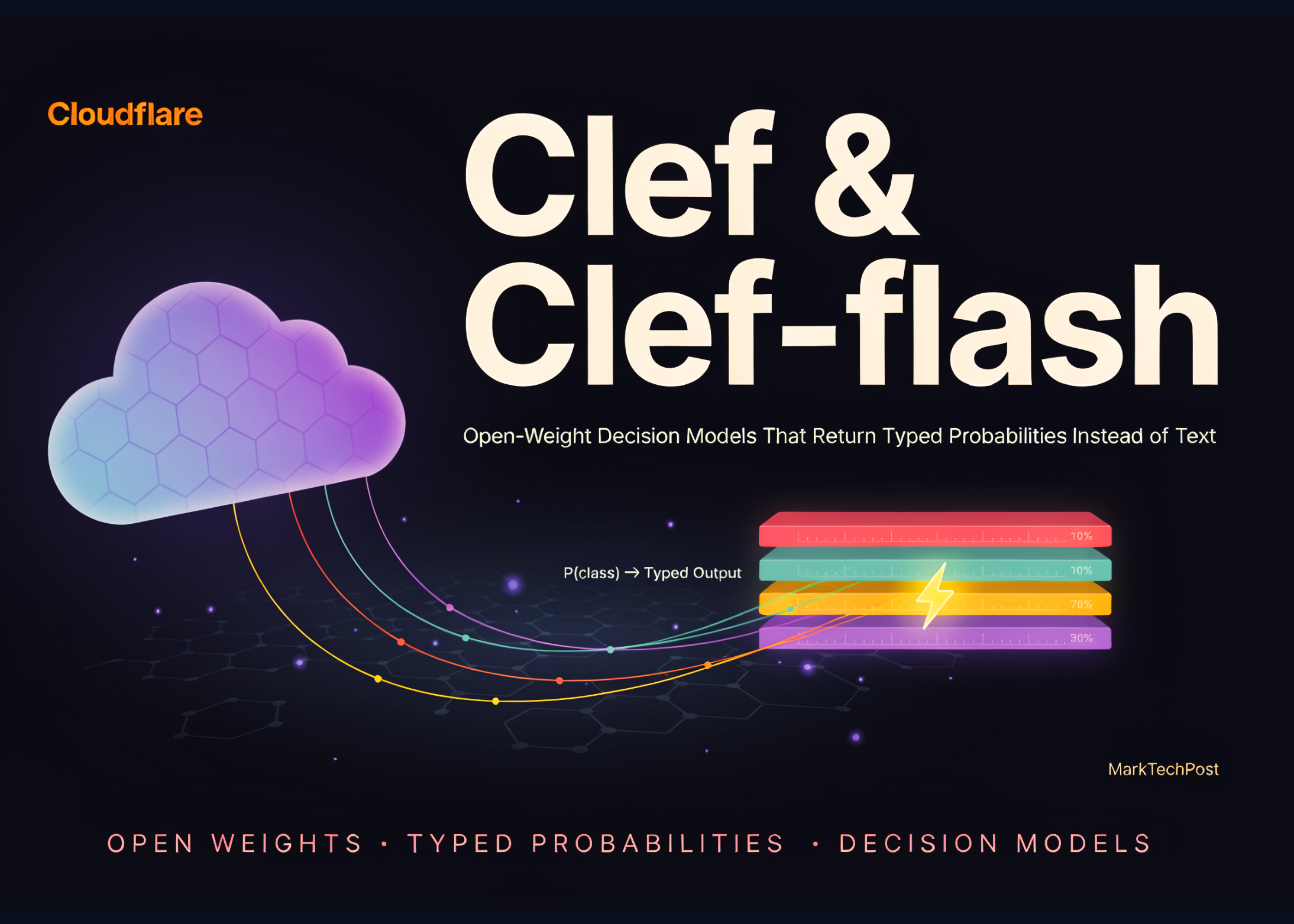
Cloudflare Releases Clef and Clef-flash: Open-Weight Decision Models That Return Typed Probabilities Instead of Text
Cloudflare has released Clef and Clef-flash, the first models trained by its Workers AI team. They are decision models, not chatbots. Each reads an input state and a schema of typed questions. It returns a probability for every allowed answer, with no free-form text. Both are open-weight under Apache 2.0 and compatible with TypeSafe AI’s Jev API. Is it deployable? Yes, Both models run today on Workers AI, and the weights are on Hugging Face for self-hosting. What a Decision Model Do