
Google releases TPU Sync open-source library
MarkTechPost: Google Releases TPU Sync: Open-Source KV Cache Transfer for TPUs
Google Cloud has released TPU Sync, an open-source C++ library for moving KV caches and model weights on Cloud TPUs. The Google TPU Sync KV cache transfer library treats TPU HBM, host DRAM, shared storage and the data center network as one memory hierarchy. It targets a growing bottleneck: moving model state, not computing it. Google reports over 90% lower KV transfer latency on 235B to 480B parameter MoE models. TL;DR Library: Native C++ core with Python wheels for PyTorch and JAX. Test
Google released TPU Sync, an open-source library that moves data stored in AI accelerator memory to other storage locations more efficiently. The tool addresses a growing challenge in AI systems: transferring model state between different memory types and locations takes significant time, often becoming a bottleneck even when computation itself is fast. In Google's internal tests, the library reduced data transfer time by over 90% for certain large AI models, and it integrates with existing AI frameworks like PyTorch and JAX. The technology is positioned as early-stage and not yet recommended for general use, with all reported performance numbers coming from Google's own testing.
One short email a day with the stories that matter. Free. Unsubscribe with one click.
Want to go deeper than the news? Explore live, cohort-based AI courses taught by practitioners.
Browse AI courses on Maven
Introducing Gemini 4 Hydrogen
Google's latest model aims to compete with other frontier AI systems in reasoning and multimodal capabilities across text, image, audio, and video.
Also reported by Ars Technica

Google’s latest Search upgrade promises better answers to your most complicated questions
Powered by Gemini 4 Hydrogen, Google's AI Mode is getting better at understanding complex queries, surfacing relevant links, and delivering richer visual responses.
Also reported by The Verge, SiliconANGLE, MarkTechPost and The Decoder
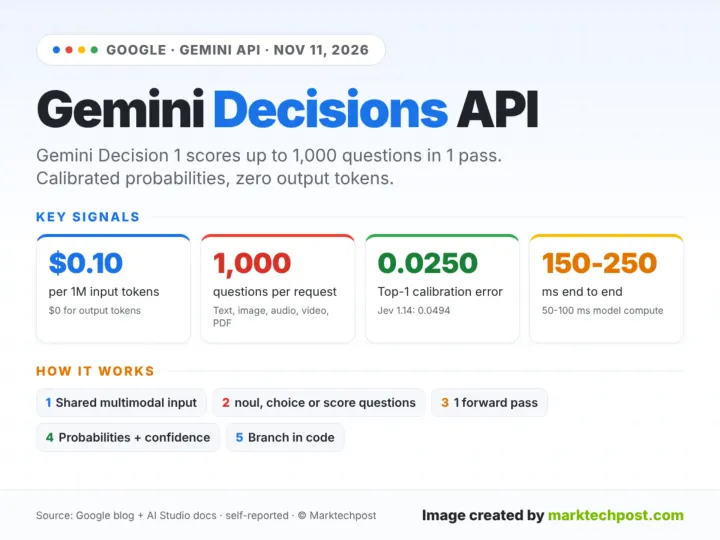
Google Launches Gemini Decisions API With Gemini Decision 1 at $0.10/M Tokens
Google has launched the Gemini Decisions API, powered by a new model, Gemini Decision 1 (gemini-decision-1). The Gemini Decisions API does not generate text. It scores up to 1,000 typed questions against one shared input and returns calibrated probabilities. For developers, this targets the small branching calls inside agents: routing, policy checks, tool selection and grading. Google prices it at $0.10 per 1M input tokens, with zero output tokens billed. TL;DR Size: Context is 262,144 t
Also reported by SiliconANGLE and The Decoder

Google releases Gemini 4 Carbon with agent ‘swarm’ feature
Google is rolling out its latest AI model, Gemini 4 Carbon, to the general public after releasing it to a select group of "cybersecurity defenders" two weeks ago. Google claims Carbon is its "strongest model" yet, and capable of competing with the very best systems from Anthropic and OpenAI. Google says Gemini 4 Carbon "pushes the frontier even further" than Argon, referring to the company's other frontier model that launched only last month. The company said Argon will likely
Gemini 4 Carbon is now available
The latest version aims to deliver improved performance while reducing the computational resources and energy required for AI operations.

Introducing AlphaProof Code: a breakthrough in verifying complex software at depth
AlphaProof Code agents wrote three million lines of proofs in Lean to verify Signal’s core encryption.