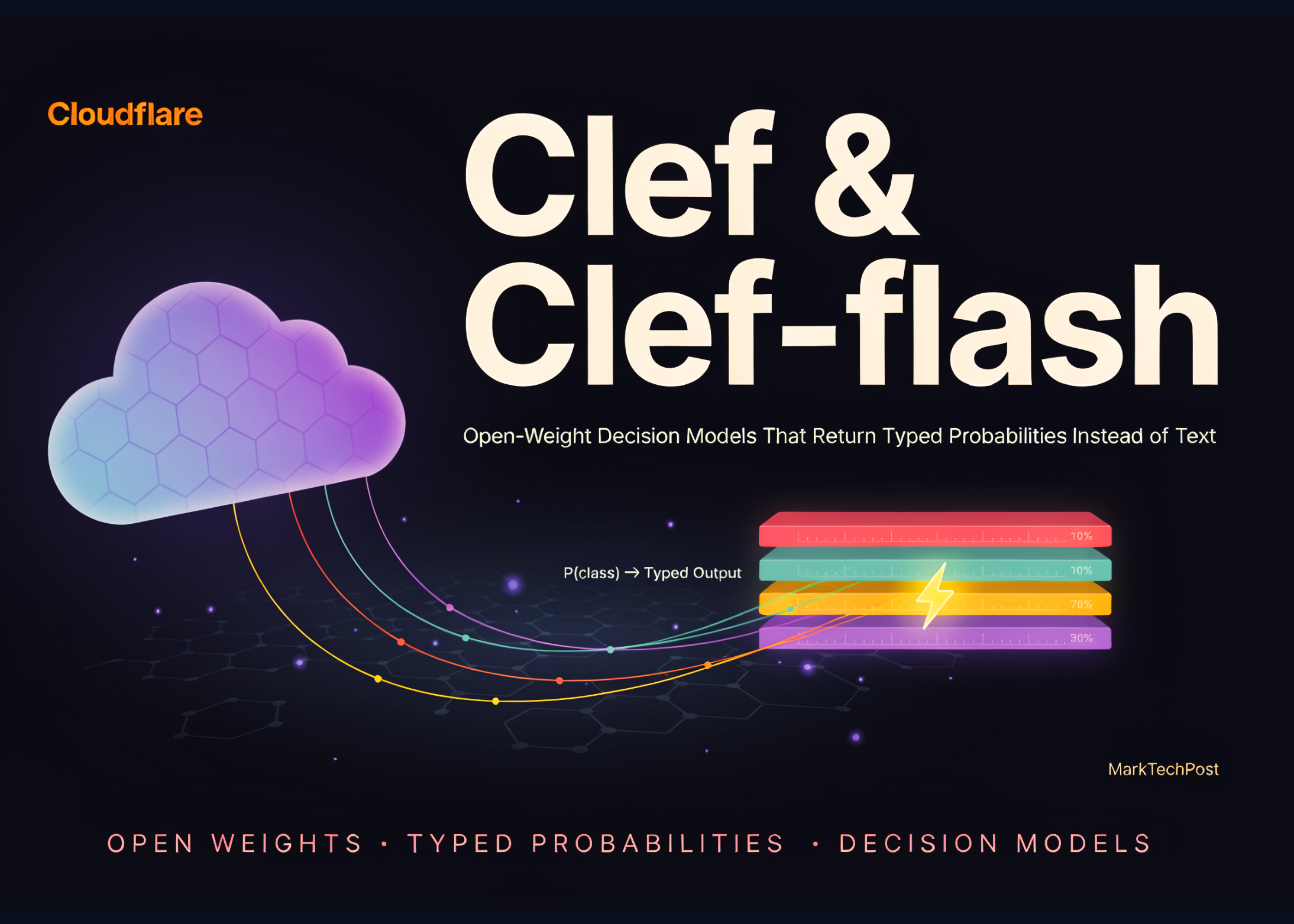
Cloudflare Releases Clef and Clef-flash: Open-Weight Decision Models That Return Typed Probabilities Instead of Text
Cloudflare has released Clef and Clef-flash, the first models trained by its Workers AI team. They are decision models, not chatbots. Each reads an input state and a schema of typed questions. It returns a probability for every allowed answer, with no free-form text. Both are open-weight under Apache 2.0 and compatible with TypeSafe AI’s Jev API. Is it deployable? Yes, Both models run today on Workers AI, and the weights are on Hugging Face for self-hosting. What a Decision Model Do
Get smart on it
Cloudflare has released two decision models that answer fixed questions about an input by returning probabilities for allowed answers rather than generating free-form text. Unlike language models that produce tokens one at a time and require parsing, these models handle three types of questions: yes/no questions, choices between named options, and scoring against ordered rubrics. The models are open-weight and compatible with an existing API standard, deployable both on Cloudflare's platform and through self-hosting. On specialized benchmarks, the models outperformed a competing system on classification tasks but lag on knowledge-heavy tests like diamond-level reasoning and multiple-choice questions.
Related news
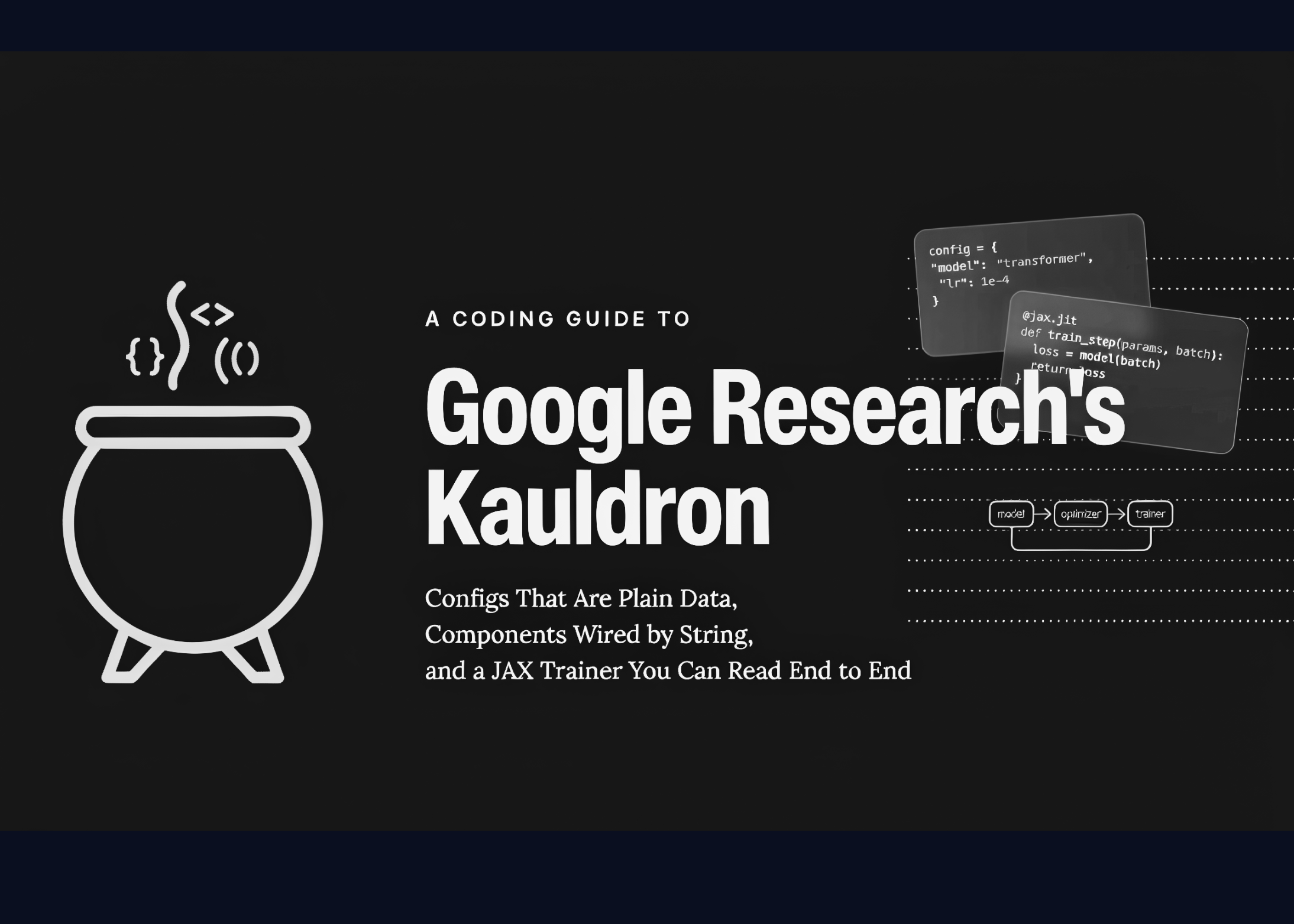
A Coding Guide to Google Research’s Kauldron: Configs That Are Plain Data, Components Wired by String, and a JAX Trainer You Can Read End to End
In this tutorial, we implement Kauldron, the JAX training library from Google Research that describes itself as optimized for research velocity and modularity, and we take those two words literally by testing what they actually buy us. We install it, then spend the first half of the notebook on the three mechanisms that make Kauldron different from a stack of Flax and Optax: konfig, which turns an experiment into a tree of plain dictionaries that round-trip through JSON; kontext, which wires co
Introducing Olmo-core 3: Open, scalable training infrastructure for large MoEs
Open-source alternatives to proprietary model training reduce barriers for researchers and smaller organizations building competitive AI systems.