
AWS Strands Labs Releases Strands Decider 2B: An Open Source Decision Model That Picks Options in About 115 ms
AWS Strands Labs releases Strands Decider 2B, an open source decision model. It does not generate text. It reads a state and typed questions, then returns a choice, a yes/no probability, or a score with a calibrated confidence. The model has 1.9 billion parameters and runs locally on a CPU, a consumer GPU, or an Apple silicon Mac. Is it deployable? Yes, for local and self-hosted use. Weights are on Hugging Face under Apache-2.0, and pip install strands-decider gives a CLI and an HTTP server.
A decision model is a type of AI that picks between options or rates them on a scale, rather than generating text like traditional language models. AWS Strands Labs released an open-source decision model with 1.9 billion parameters that answers three types of questions: choosing one option from multiple choices, providing yes/no probabilities, or scoring on an ordered rubric. The model runs locally on standard hardware and completes requests in about 115 milliseconds, making it suitable for tasks like routing decisions, tool selection, and guardrails in AI systems. This represents a new category of models designed to constrain AI outputs to specific decision types rather than allowing arbitrary text generation.
One short email a day with the stories that matter. Free. Unsubscribe with one click.
Want to go deeper than the news? Explore live, cohort-based AI courses taught by practitioners.
Browse AI courses on Maven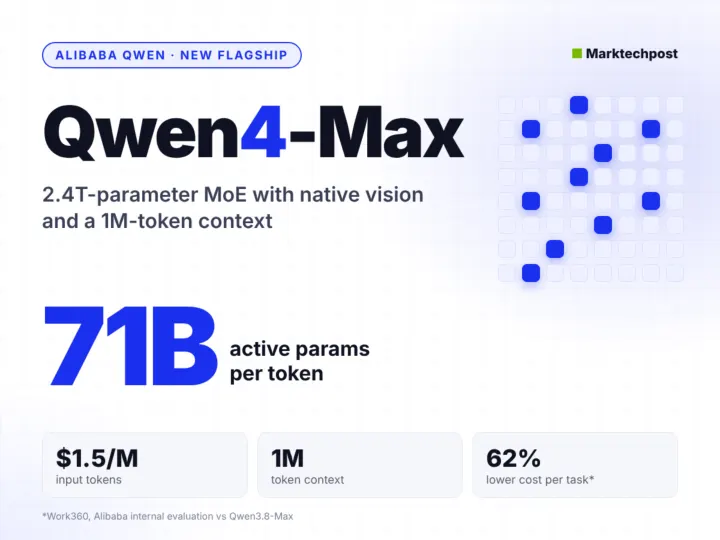
Alibaba Releases Qwen4-Max: 2.4T MoE, 71B Active, 1M Context
Alibaba’s Qwen team has released Qwen4-Max, the first model of its Qwen4 generation. Qwen4-Max is a proprietary sparse MoE model with a 2.4T-parameter backbone and 71B parameters active per token. It accepts text, images and video, and supports a 1M-token context window. Alibaba also cut API prices and reports a 62% drop in average cost per task. TL;DR Size: 2.4T backbone parameters, 71B active per token, plus 328B N-gram Embedding parameters. 1M context, 393K max output tokens.
Also reported by SiliconANGLE
Introducing Gemini 4 Hydrogen
Google's latest model aims to compete with other frontier AI systems in reasoning and multimodal capabilities across text, image, audio, and video.
Also reported by Ars Technica

Google’s latest Search upgrade promises better answers to your most complicated questions
Powered by Gemini 4 Hydrogen, Google's AI Mode is getting better at understanding complex queries, surfacing relevant links, and delivering richer visual responses.
Also reported by The Verge, SiliconANGLE, MarkTechPost and The Decoder
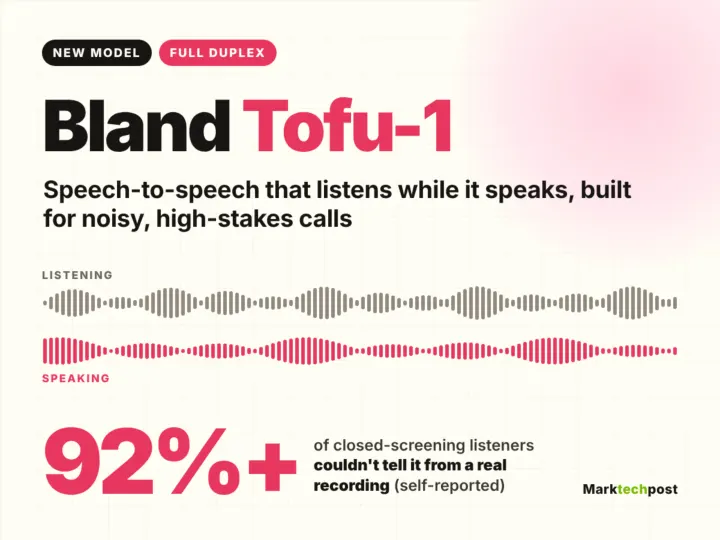
Bland Launches Tofu-1, a Full-Duplex Speech-to-Speech Model for Calls
Bland, the San Francisco voice-AI company, has released Tofu-1, a full-duplex speech-to-speech model in research preview. The Tofu-1 speech-to-speech model targets calls from moving cars, hospital rooms and weak-signal lines. It listens while it speaks and reasons while it talks. For phone-agent teams, one model now handles audio in and audio out, with no transcript between. You can check the deployment options and specs here through our GPULeaderboard.com chrome extension. What is Tofu-1?
ElevenLabs Scribe v3 Live uses conversational context to stop voice agents from cutting off callers mid-sentence
ElevenLabs has released Scribe v3 and Scribe v3 Live, two new speech recognition models designed to transcribe accurately through background noise and crosstalk. Benchmarks from Artificial Analysis confirm that Scribe v3 narrowly beats competitors like OpenAI, Google, and Microsoft on accuracy. That precision comes at a cost, though. Rivals like Microsoft and xAI run many times faster and charge roughly half the price. The article ElevenLabs Scribe v3 Live uses conversational context to

Google Deepmind shifts genomics AI from bulk tissue predictions to single cell type resolution with AlphaGenome 2
Google Deepmind has unveiled AlphaGenome 2, an AI model that analyzes genetic variants for individual cell types rather than across bulk tissue. Trained on more than 107 million cell profiles, it identifies nearly twice as many disease-relevant gene changes as its predecessor. The model is available for noncommercial research through an API and is set to be integrated into Google's agentic platform Antigravity. The article Google Deepmind shifts genomics AI from bulk tissue predictions