
Amazon releases its own Jev clone as decision models flood the web
Amazon Web Services' Strand Labs has released the latest Jevalike decision model, Strands Decider 2B.
Amazon released an open-source decision model designed to help AI workflows make choices between pre-set options rather than generate open-ended text like traditional large language models. Decision models like this one are smaller, faster, and cheaper than full-featured language models, making them useful for specific tasks in automated workflows where users need reliable choices with confidence scores rather than general-purpose intelligence. The release reflects growing interest in this class of models, with dozens of similar tools produced by researchers since the original model was introduced, though some question how valuable they will ultimately be. Amazon's engineer noted the challenge lies in optimizing the model's speed and accuracy while preserving its ability to understand language and work across different domains.
One short email a day with the stories that matter. Free. Unsubscribe with one click.
Want to go deeper than the news? Explore live, cohort-based AI courses taught by practitioners.
Browse AI courses on Maven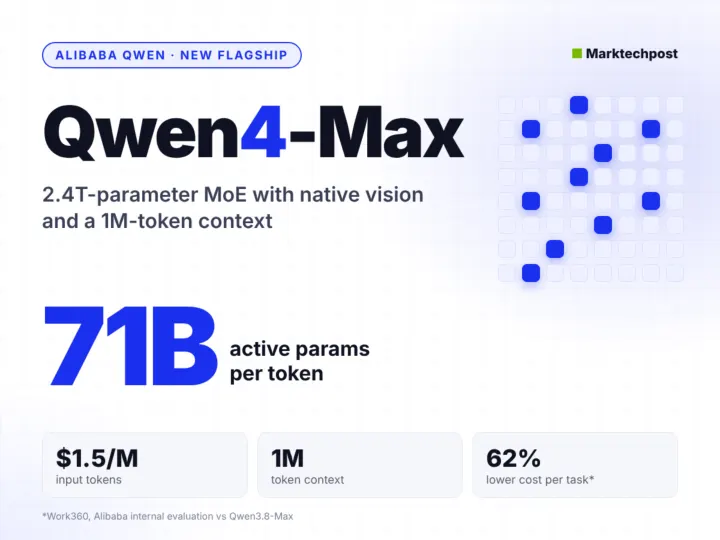
Alibaba Releases Qwen4-Max: 2.4T MoE, 71B Active, 1M Context
Alibaba’s Qwen team has released Qwen4-Max, the first model of its Qwen4 generation. Qwen4-Max is a proprietary sparse MoE model with a 2.4T-parameter backbone and 71B parameters active per token. It accepts text, images and video, and supports a 1M-token context window. Alibaba also cut API prices and reports a 62% drop in average cost per task. TL;DR Size: 2.4T backbone parameters, 71B active per token, plus 328B N-gram Embedding parameters. 1M context, 393K max output tokens.
Also reported by SiliconANGLE
Introducing Gemini 4 Hydrogen
Google's latest model aims to compete with other frontier AI systems in reasoning and multimodal capabilities across text, image, audio, and video.
Also reported by Ars Technica

Google’s latest Search upgrade promises better answers to your most complicated questions
Powered by Gemini 4 Hydrogen, Google's AI Mode is getting better at understanding complex queries, surfacing relevant links, and delivering richer visual responses.
Also reported by The Verge, SiliconANGLE, MarkTechPost and The Decoder
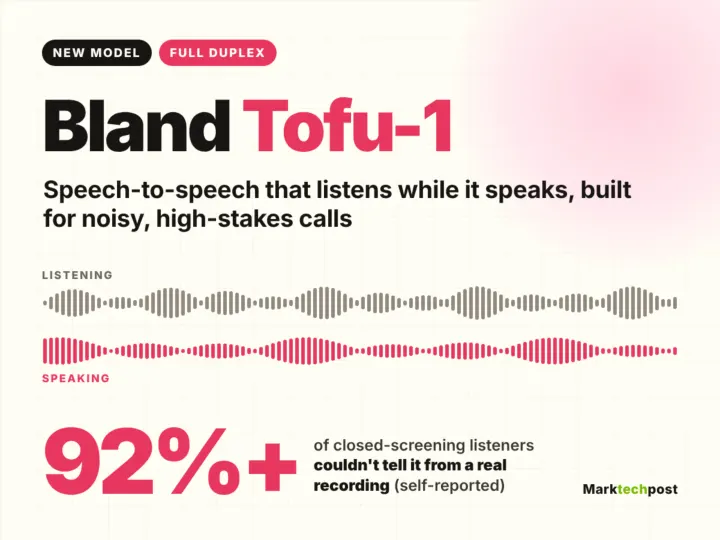
Bland Launches Tofu-1, a Full-Duplex Speech-to-Speech Model for Calls
Bland, the San Francisco voice-AI company, has released Tofu-1, a full-duplex speech-to-speech model in research preview. The Tofu-1 speech-to-speech model targets calls from moving cars, hospital rooms and weak-signal lines. It listens while it speaks and reasons while it talks. For phone-agent teams, one model now handles audio in and audio out, with no transcript between. You can check the deployment options and specs here through our GPULeaderboard.com chrome extension. What is Tofu-1?
ElevenLabs Scribe v3 Live uses conversational context to stop voice agents from cutting off callers mid-sentence
ElevenLabs has released Scribe v3 and Scribe v3 Live, two new speech recognition models designed to transcribe accurately through background noise and crosstalk. Benchmarks from Artificial Analysis confirm that Scribe v3 narrowly beats competitors like OpenAI, Google, and Microsoft on accuracy. That precision comes at a cost, though. Rivals like Microsoft and xAI run many times faster and charge roughly half the price. The article ElevenLabs Scribe v3 Live uses conversational context to

Google Deepmind shifts genomics AI from bulk tissue predictions to single cell type resolution with AlphaGenome 2
Google Deepmind has unveiled AlphaGenome 2, an AI model that analyzes genetic variants for individual cell types rather than across bulk tissue. Trained on more than 107 million cell profiles, it identifies nearly twice as many disease-relevant gene changes as its predecessor. The model is available for noncommercial research through an API and is set to be integrated into Google's agentic platform Antigravity. The article Google Deepmind shifts genomics AI from bulk tissue predictions