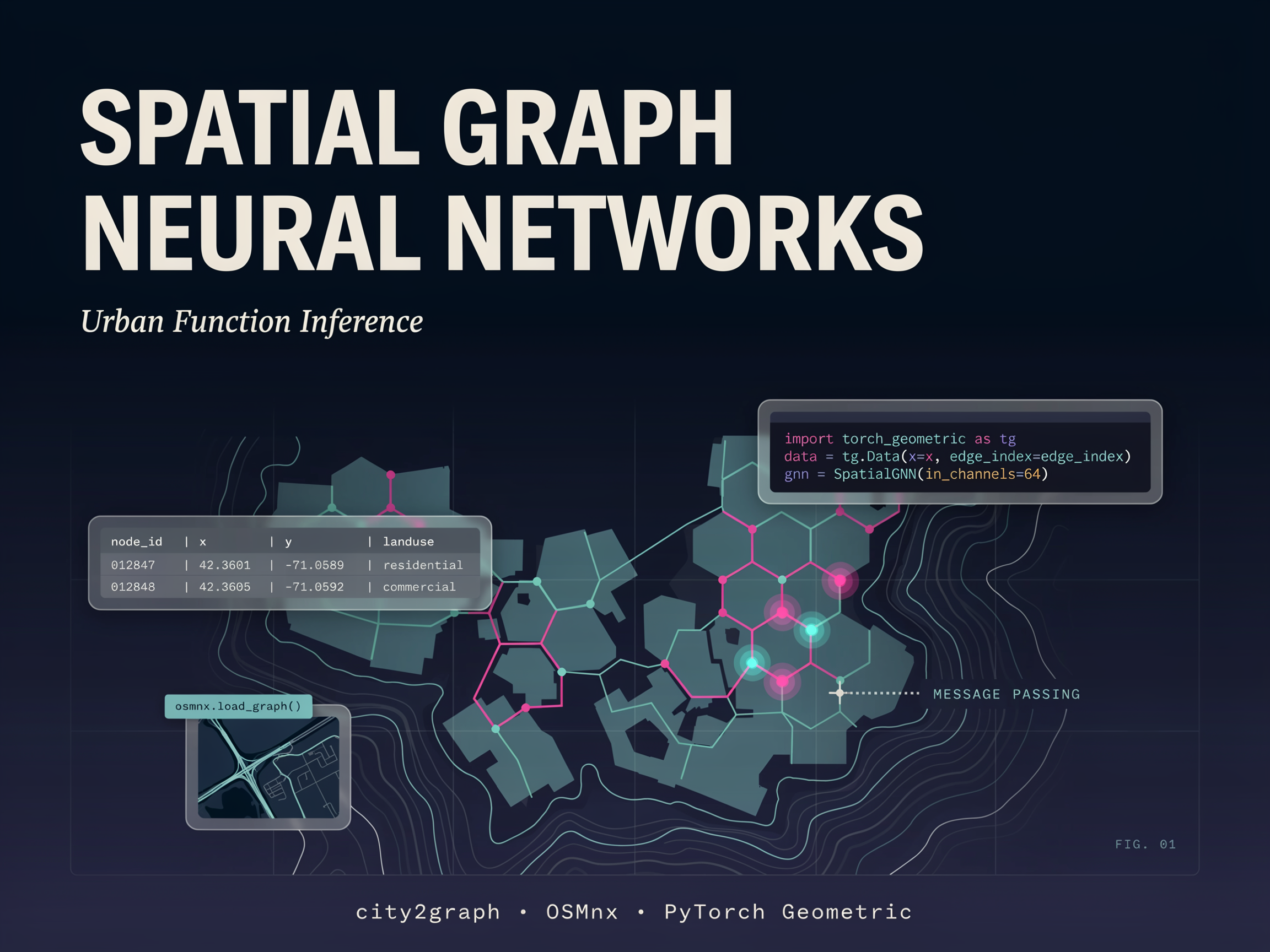
A Coding Implementation on Spatial Graph Neural Networks for Urban Function Inference Using city2graph, OSMnx, and PyTorch Geometric
In this tutorial, we build an end-to-end spatial graph learning pipeline using city2graph. We start by collecting real urban POI data and street network information from OpenStreetMap, with a synthetic fallback to ensure the workflow remains reliable. We then engineer spatial features, construct multiple proximity graph families, and compare how different graph-building strategies represent the same urban environment. After that, we create both heterogeneous and homogeneous graph structures, co
Get smart on it
The lesson for this story is being written.
Related news

Mistral OCR 4 Brings Citation-Ready Structured Output to RAG, Agentic, and Enterprise Search Pipelines
Today, Mistral AI released OCR 4, its latest document-understanding model. This new release adds bounding boxes, block classification, and inline confidence scores alongside extracted text. It supports 170 languages across 10 language groups and runs in a single container for fully self-hosted deployments. OCR 4 also serves as an ingestion component for enterprise search, RAG, and domain-specific retrieval pipelines. TL;DR OCR 4 returns bounding boxes, typed-block labels, and per-word c

Datalab Releases lift: A 9B Open-Weights Vision Model That Extracts Structured JSON From PDFs Using Schemas
Datalab has released lift, a 9B open-weights vision model for structured extraction. You pass it a JSON schema, and it returns a JSON object that matches. The model reads PDFs and images directly, then decodes against your schema. This is Datalab’s first model built purely for extraction. The team already ships open-source OCR tools: chandra, marker, and surya. lift extends that work into schema-driven field extraction. lift scores 90.2% field accuracy on Datalab’s 225-documen