20 Agentic Use Cases of TypeSafe AI’s Jev
Last week, TypeSafe AI released Jev, its first System One model. Founder Diogo Almeida previously worked at OpenAI on the instruction-following research behind ChatGPT. Jev does not chat, write code or summarize. It takes unstructured state and returns typed decisions with calibrated probabilities. That makes it a natural fit for the thousands of small judgments inside an agent loop: which model to call, whether a command is safe, which passage is relevant, whether the agent is actually don
Get smart on it
TypeSafe AI released a decision-making model called Jev that returns typed answers with probability scores instead of generated text. Unlike traditional chatbots, Jev takes unstructured information and makes specific judgments suited for agent loops, such as choosing which model to call, evaluating whether commands are safe, or determining if a task is complete. The model works through three primitives: Choice selects one option from a list with probabilities, Score rates information on a rubric, and Noul returns the probability that a statement is true. Jev is designed for thousands of small judgments within AI agents, with applications ranging from routing requests between models to detecting prompt injections and controlling browser or computer interfaces.
Related news
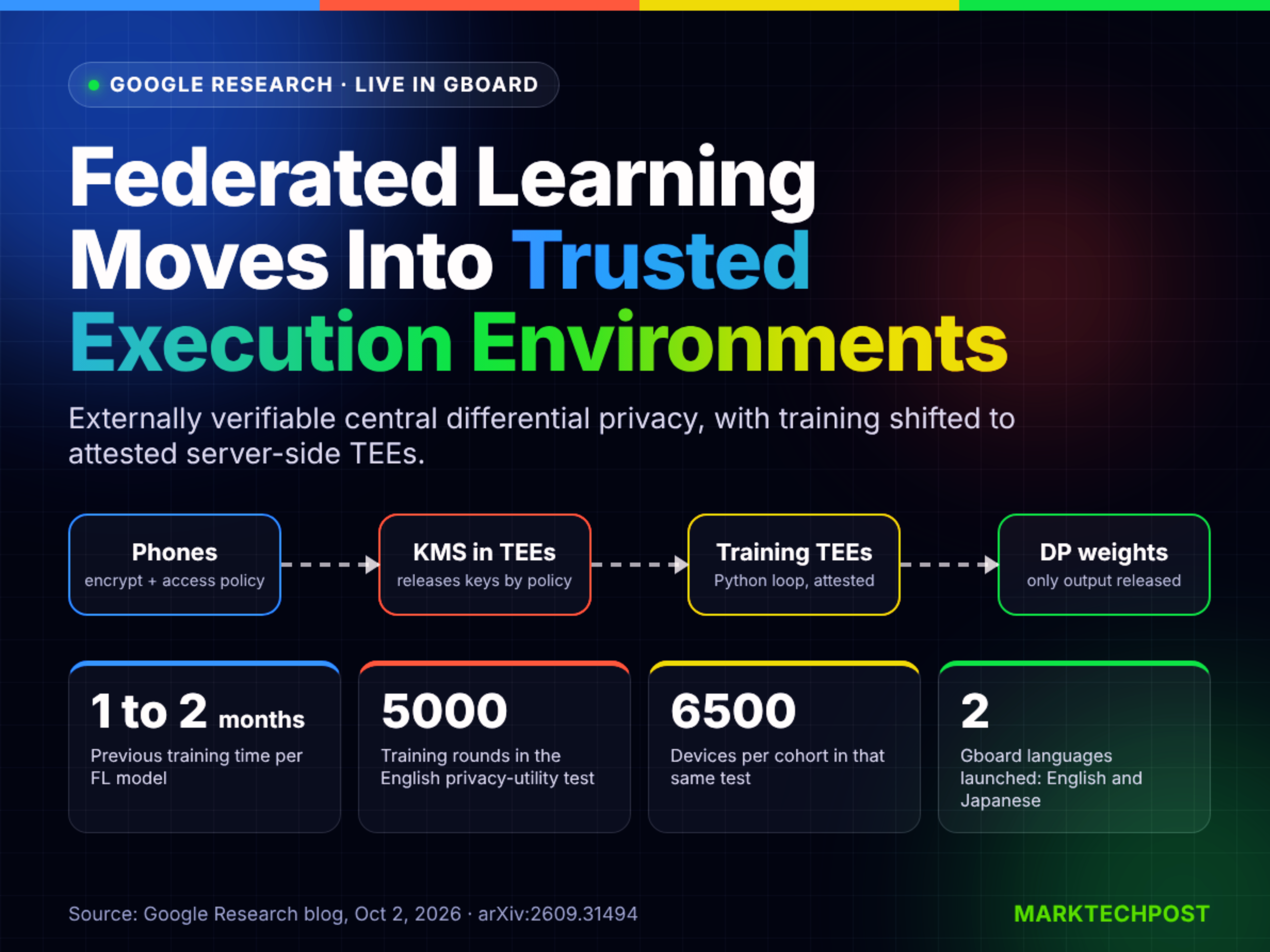
Google Research Moves Federated Learning Into TEEs: Gboard Now Trains With Externally Verifiable Differential Privacy
Google Research has announced a next-generation Federated Learning (FL) system built on Trusted Execution Environments (TEEs). The research team claims externally verifiable central differential privacy (DP) guarantees for FL for the first time. What Problem Does TEE-Based Federated Learning Solve? Google introduced Federated Learning FL in 2017. It powers next-word prediction and Smart Compose on Gboard, reply suggestions in Google Messages, and Smart Text Selection in Android. Earli
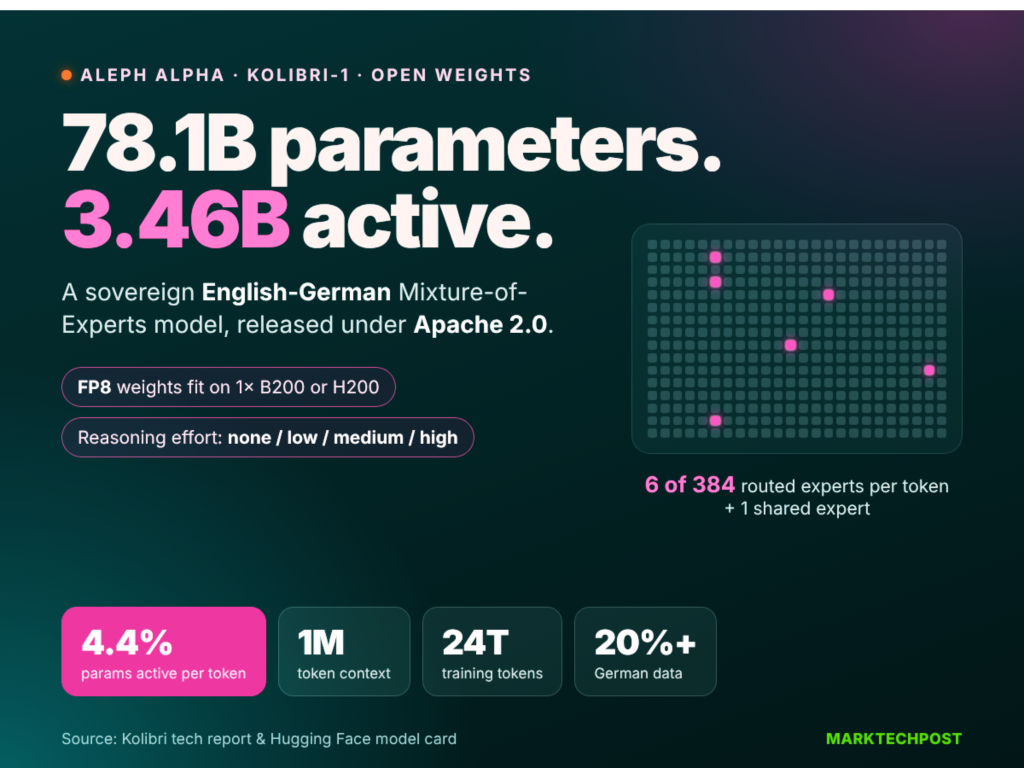
Aleph Alpha Releases Kolibri: A 78.1B Open-Weight English-German MoE Model With Only 3.46B Active Parameters
Aleph Alpha has released Kolibri, an open-weight Mixture-of-Experts (MoE) language model built for German and English. Kolibri has 78.1B total parameters but activates only 3.46B, or 4.4%, per token. It accepts up to 1,048,576 tokens of context, lets users set reasoning effort per request, and ships under the Apache 2.0 license on Hugging Face. The target is sovereign deployment in regulated sectors such as public administration, industry and aerospace. Is it deployable? Yes. The FP8 checkpo