
Crusoe investor backs solar power for AI data centers
TechCrunch: Why a Crusoe investor is betting on solar and batteries to power future AI data centers
Next-generation data centers will need tens of gigawatts of power every year. One of Crusoe's investors thinks solar and energy storage are the obvious choice.
AI data centers require massive amounts of power, and U.S. grid demand is growing faster than supply can keep up. A venture investor argues that solar paired with long-duration energy storage is a better solution than the natural gas power plants companies are currently deploying, because solar manufacturing capacity far exceeds natural gas capacity and both technologies use modular, scalable designs that follow Wright's Law. Building data centers off-grid with renewables could allow companies to avoid grid permitting constraints and accelerate their time to market, though long-duration energy storage technologies are still a few years away from broad adoption among data center developers.
- Anthropic's appetite for compute is pushing xAI toward a rent-over-build strategy · The Decoder
- Architect Labs Unveils Frostbite, an Interaction Net CPU Designed by AI · MarkTechPost
- Meta TLX Brings Warp-Group GPU Control to Triton on Hopper, Blackwell, AMD · MarkTechPost
- All of today’s AI news, biggest first →
One short email a day with the stories that matter. Free. Unsubscribe with one click.
Want to go deeper than the news? Explore live, cohort-based AI courses taught by practitioners.
Browse AI courses on Maven
Anthropic's appetite for compute is pushing xAI toward a rent-over-build strategy
Since May, SpaceXSI has been renting compute to competitors like Anthropic and Google while scaling back its own AI projects. Anthropic pays about $3.1 billion a month, Google $800 million, the New York Times reports. After its June IPO, SpaceXSI disbanded the 60-person Grok Imagine team, among other cuts. The article Anthropic's appetite for compute is pushing xAI toward a rent-over-build strategy appeared first on The Decoder.
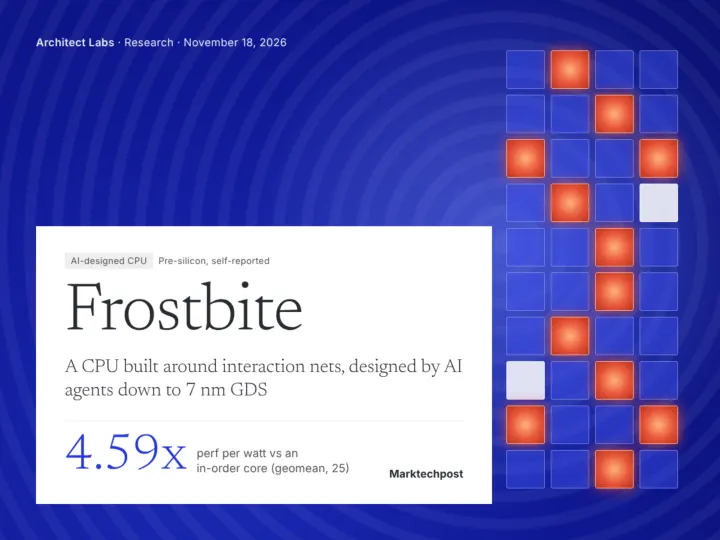
Architect Labs Unveils Frostbite, an Interaction Net CPU Designed by AI
Architect Labs has introduced Frostbite, an AI-designed CPU with a new instruction set built around interaction nets. The company states that its AI agents designed Frostbite from interaction net theory down to final GDS. In pre-silicon tests, it reports 4.59x the performance per watt of a modern in-order CPU core. TL;DR Size: 1 quad (2×2 tiles) plus 4 L3 nodes takes 0.792 mm² on 7 nm. No parameter count (it is a CPU). Runs on: Pre-silicon only. Final GDS closes at 500 MHz on 7
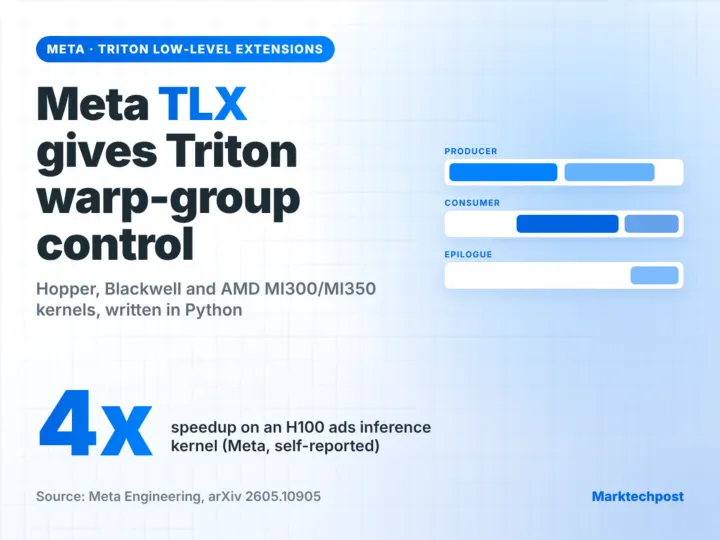
Meta TLX Brings Warp-Group GPU Control to Triton on Hopper, Blackwell, AMD
Meta has published a detailed report on TLX (Triton Low-Level Extensions). It is the GPU compiler extension behind Meta’s production ML kernels. Meta TLX is a Triton extension that exposes warp groups, barriers, TMA and clusters to Python kernels. It targets NVIDIA Hopper and Blackwell plus AMD MI300 and MI350-series GPUs. For kernel engineers, the message is CUDA-level control without leaving Triton. TL;DR What it is: an extension to Triton, not a new language. A Blackwell GEMM ta

Inference now drives two-thirds of AI workloads, changing where chips get deployed
AI spending is shifting from giant training clusters toward smaller, quickly built sites, and modular data centers are becoming a natural home for inference workloads. Power, cooling and memory supply now shape where tokens get generated as much as raw chip performance does. Inference-first chipmakers want to capture that shift. Positron AI Inc., which raised […] The post Inference now drives two-thirds of AI workloads, changing where chips get deployed appeared first on SiliconANGLE.

AI deals shrink to as little as 30 days as the data layer sets the pace
Artificial intelligence has turned data infrastructure from a back-office purchase into the bottleneck that decides how fast GPUs pay off. As hyperscalers, neoclouds and enterprises race to expand their data layers, the way that infrastructure gets bought is changing just as fast. The storage industry’s longtime performance specialist sees that shift as its opening. DataDirect […] The post AI deals shrink to as little as 30 days as the data layer sets the pace appeared first on Silic

Enterprise AI is pushing cloud infrastructure beyond the GPU
Enterprise adoption of artificial intelligence is creating new requirements for enterprise AI infrastructure. While much of the early AI investment centered on access to powerful GPUs, organizations moving AI applications and agents into production are discovering that accelerators are only one part of the equation. Agentic AI systems need environments where they can execute code, […] The post Enterprise AI is pushing cloud infrastructure beyond the GPU appeared first on SiliconANGLE.