
SoftBank loses billions on AI data center power
TechCrunch: SoftBank’s billion-dollar loss may have put a cap on AI’s natural gas ambitions
SoftBank lost over $3 billion pre-ordering natural gas turbines to power AI data centers. Here's what the loss means to power markets.
An investment firm announced a major quarterly loss, with over half stemming from losses related to power-generating equipment used for data centers. The firm had previously ordered significantly more turbines than it needed, paying nonrefundable deposits to secure them quickly amid competition for equipment needed to power AI data centers. Data center operators are now reconsidering natural gas as their primary power source and may instead opt for grid connections combined with large batteries, which could slow growth in the natural gas market more than the investment firm anticipated.
One short email a day with the stories that matter. Free. Unsubscribe with one click.
Want to go deeper than the news? Explore live, cohort-based AI courses taught by practitioners.
Browse AI courses on Maven
Ars Live: What drone attacks on data centers mean for modern life in the cloud
Drone and missile strikes have inflicted unprecedented damage on data centers in Eastern Europe and the Middle East this year, disrupting cloud services for millions of people and permanently deleting some Amazon Web Services customer data. This trend represents a new concern for Big Tech companies—but also for governments and everyone else who depends on common digital services in modern life. To explore what this all means for modern society’s reliance on cloud resilience, I will be hosting a

As AI agents take control, Nvidia rethinks the security playbook
Nvidia Corp. recently added a new pillar to its AI networking infrastructure with the unveiling of Scale-In. Scale-In brings purpose-built acceleration to secure, manage and operate agentic AI factories. It is designed to deliver secure access, high-performance data movement, tenant isolation, simpler operations and more predictable performance as agents assume increasingly larger roles within AI […] The post As AI agents take control, Nvidia rethinks the security playbook appeared first o

Nebius tests the neocloud playbook with $40 billion in planned spending
Nebius plans to fund its $40 billion AI infrastructure expansion through customer prepayments and loans, even as delays at a Microsoft data center raise questions about its financing model.
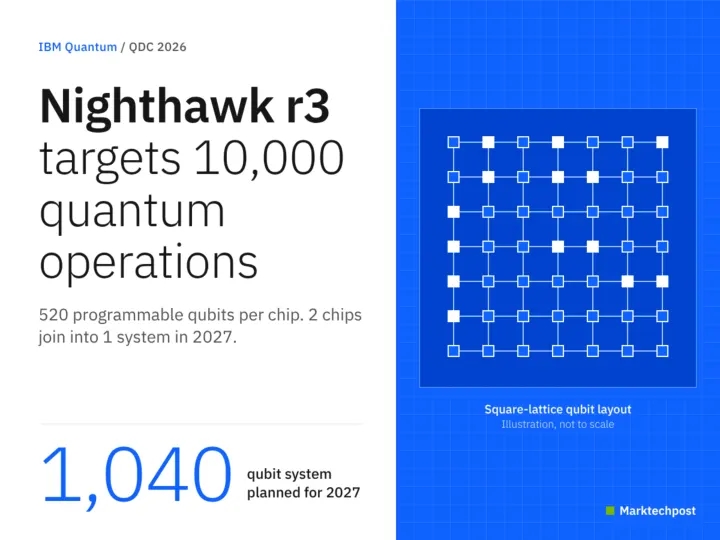
IBM Announces IBM Quantum Nighthawk r3: A New Processor to Support 10k Quantum Operations on 520 Programmable Qubits
IBM has announced IBM Quantum Nighthawk r3, its next superconducting quantum processor. It is designed to run 10,000 quantum operations accurately across 520 programmable qubits. In 2027, IBM plans to link 2 r3 chips into a single 1,040-qubit system. For developers, the announcement is speed. The current Nighthawk r2 already runs workloads up to 19x faster than IBM’s earlier processors. TL;DR Size: Nighthawk r3: 520 programmable qubits, 2,034 physical qubits, 10 l-couplers. Nightha

Why the data center you dread might never even be built
The data center boom is running into serious real-world obstacles, from widespread local opposition and permitting delays to a scramble for electricity. Before those challenges even come into play, though, there’s a more basic problem: A lot of the projects being announced may never get built in the first place. With billions of dollars in AI infrastructure […]

How backlash and red tape continue to slow data centers post-Blue Wave
The data center boom is running into serious real-world obstacles, from widespread local opposition and permitting delays to a scramble for electricity. Before those challenges even come into play, though, there’s a more basic problem: A lot of the projects being announced may never get built in the first place. With billions of dollars in AI infrastructure […]