
Data center developers face growing public opposition
Data Center Knowledge: Public Pushback Complicates Data Center Buildouts
Developers face closer scrutiny of utility costs, water use, and local benefits as community concerns complicate approvals and investment decisions.
Data center developers are facing increasing public opposition to construction projects, with communities voting for stricter restrictions on development and raising concerns about electricity costs, water use, and local impacts. Political leaders in multiple states have shifted from supporting rapid data center expansion to backing slower timelines and stronger environmental and transparency requirements. The added scrutiny means developers must now factor in community acceptance, zoning decisions, utility agreements, and environmental approvals alongside traditional project planning, with average timelines from announcement to construction rising from 18 months to over two years. Developers are being pressed to put their commitments about infrastructure, power sourcing, water sourcing, and community benefits in writing to win local approval.
- Meta TLX Brings Warp-Group GPU Control to Triton on Hopper, Blackwell, AMD · MarkTechPost
- Inference now drives two-thirds of AI workloads, changing where chips get deployed · SiliconANGLE
- AI deals shrink to as little as 30 days as the data layer sets the pace · SiliconANGLE
- All of today’s AI news, biggest first →
One short email a day with the stories that matter. Free. Unsubscribe with one click.
Want to go deeper than the news? Explore live, cohort-based AI courses taught by practitioners.
Browse AI courses on Maven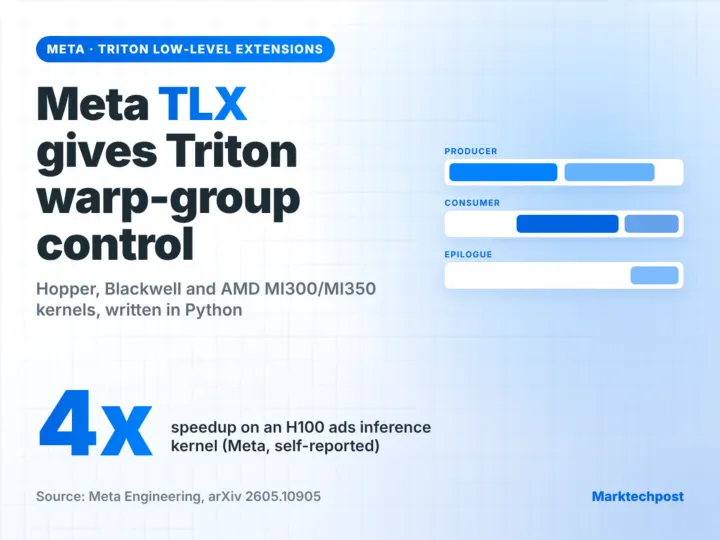
Meta TLX Brings Warp-Group GPU Control to Triton on Hopper, Blackwell, AMD
Meta has published a detailed report on TLX (Triton Low-Level Extensions). It is the GPU compiler extension behind Meta’s production ML kernels. Meta TLX is a Triton extension that exposes warp groups, barriers, TMA and clusters to Python kernels. It targets NVIDIA Hopper and Blackwell plus AMD MI300 and MI350-series GPUs. For kernel engineers, the message is CUDA-level control without leaving Triton. TL;DR What it is: an extension to Triton, not a new language. A Blackwell GEMM ta

Inference now drives two-thirds of AI workloads, changing where chips get deployed
AI spending is shifting from giant training clusters toward smaller, quickly built sites, and modular data centers are becoming a natural home for inference workloads. Power, cooling and memory supply now shape where tokens get generated as much as raw chip performance does. Inference-first chipmakers want to capture that shift. Positron AI Inc., which raised […] The post Inference now drives two-thirds of AI workloads, changing where chips get deployed appeared first on SiliconANGLE.

AI deals shrink to as little as 30 days as the data layer sets the pace
Artificial intelligence has turned data infrastructure from a back-office purchase into the bottleneck that decides how fast GPUs pay off. As hyperscalers, neoclouds and enterprises race to expand their data layers, the way that infrastructure gets bought is changing just as fast. The storage industry’s longtime performance specialist sees that shift as its opening. DataDirect […] The post AI deals shrink to as little as 30 days as the data layer sets the pace appeared first on Silic

Enterprise AI is pushing cloud infrastructure beyond the GPU
Enterprise adoption of artificial intelligence is creating new requirements for enterprise AI infrastructure. While much of the early AI investment centered on access to powerful GPUs, organizations moving AI applications and agents into production are discovering that accelerators are only one part of the equation. Agentic AI systems need environments where they can execute code, […] The post Enterprise AI is pushing cloud infrastructure beyond the GPU appeared first on SiliconANGLE.
NVIDIA and Microsoft Expand Accelerated Computing From Azure to Windows PCs
NVIDIA and Microsoft are extending their full-stack collaboration to help organizations build, customize and deploy intelligent applications — from next-generation infrastructure on Azure to industrial systems and Windows PCs. At Microsoft Ignite, the companies are expanding access to Azure virtual machines powered by NVIDIA Vera Rubin NVL72 systems, as well as adding customer availability to NVIDIA open models and customization capabilities through Microsoft Foundry, and new options for running

D-Matrix bets stacked DRAM can solve inference’s memory bandwidth problem
As artificial intelligence workloads shift to inference, memory bandwidth decides whether hardware generates tokens quickly or sits idle. D-Matrix Corp. is answering with Raptor, a second-generation chip stacking 3D DRAM beneath its compute logic. AI infrastructure has become a systems game, and winners combine memory, interconnect and software into cohesive designs, according to Satyam Srivastava […] The post D-Matrix bets stacked DRAM can solve inference’s memory bandwidth problem