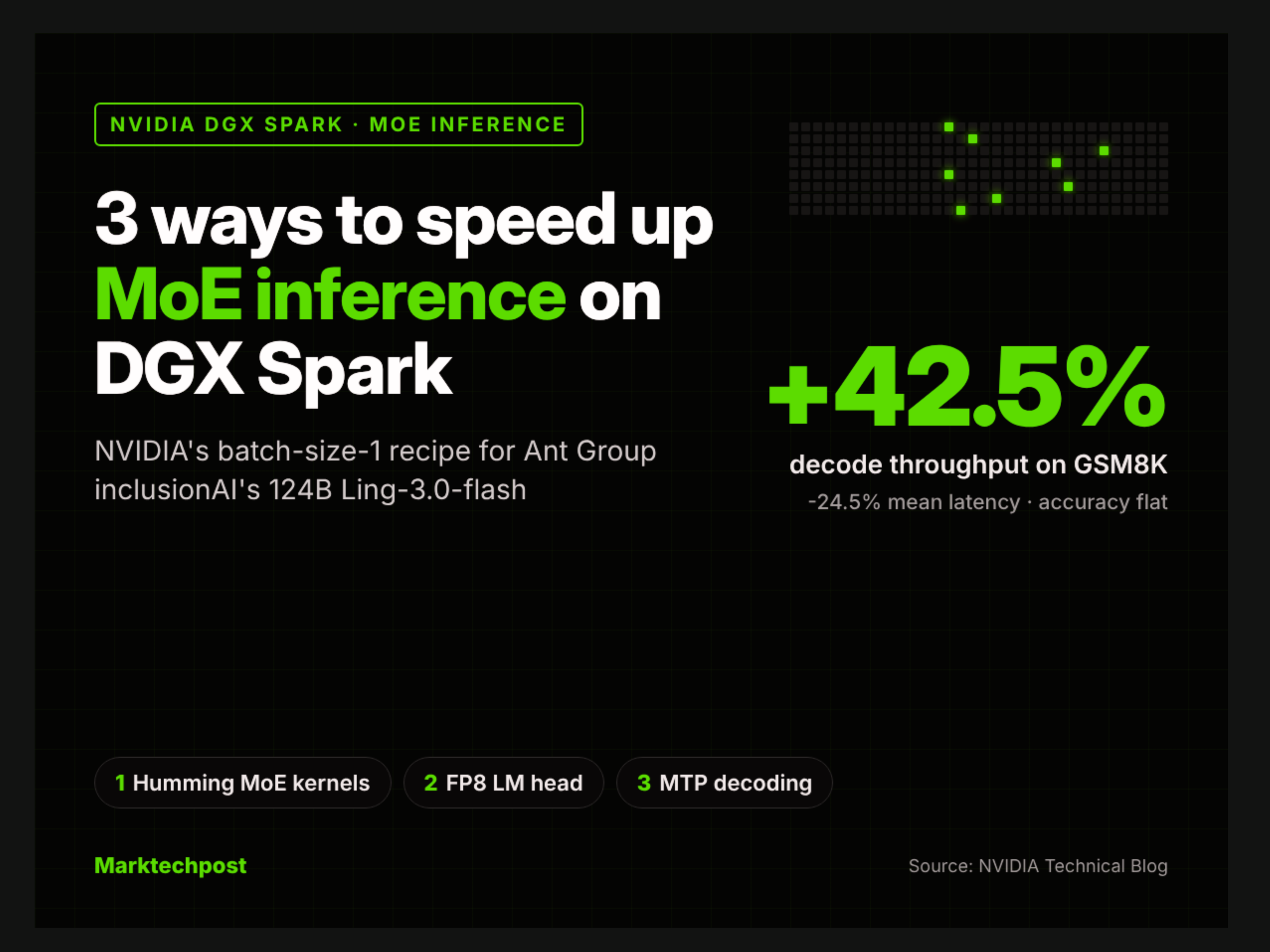
NVIDIA speeds up MoE inference throughput 42.5 percent
MarkTechPost: NVIDIA Shows 3 Ways to Speed Up MoE Inference on DGX Spark, Lifting Ling-3.0-flash Throughput 42.5%
NVIDIA’s latest technical blog shows how to speed up mixture-of-experts (MoE) inference on one DGX Spark. The test model is Ant Group inclusionAI’s Ling-3.0-flash, a 124B-parameter MoE with 5.1B active parameters. NVIDIA stacked three optimizations: a new MoE kernel backend, an FP8 output layer and built-in speculative decoding. On all 1,319 GSM8K questions, decode throughput rose 42.5% with no statistically detectable accuracy change. So why is it relevant for Devs? DGX Spark is a desktop s
Get smart on it
NVIDIA demonstrated three optimization techniques for speeding up mixture-of-experts model inference on a desktop system, achieving a 42.5% increase in throughput when processing real-world question-answering tasks. The optimizations involved replacing a standard kernel library with an alternative, converting a specific model layer to lower precision, and implementing speculative decoding that drafts multiple tokens at once. The improvements matter because they show that large models with 124 billion total parameters can run faster on desk-side hardware without sacrificing accuracy, and the techniques reveal which parts of the inference process consume the most time and memory bandwidth.
Explainer: What Is a Mixture of Experts Model and Why Does It Use Fewer Resources?
Relevant courses
Want to go deeper than the news? Explore live, cohort-based AI courses taught by practitioners.
Browse AI courses on MavenRelated news

Elon Is Doing It Again: SpaceX Will Be The World’s Biggest AI Cloud
We wrote at length about how SpaceX’s plans for 10GW in 2027 was feasible, paving the way for +300b+ ARR. We received a lot of pushback from folks calling it impossible. Now, just two months later, we’re already seeing 3.6GW under construction across multiple sites, both existing and new. SpaceX has even revised its estimate up to ~13GW in 2027. This would be the largest amount of datacenter capacity ever built by any one company in that timeframe, roughly equivalent to all of Google

Data centers are turning to old jet engines as the wait for power grows
The years-long wait for access to the grid and new turbines is causing data center builders to turn to an unusual, less efficient and less environmentally friendly solution: once-discarded jet engines.
Ukraine’s drone strikes spur hasty Russian plans for underground data centers
Russian tech companies are scrambling to harden and hide their data centers underground after Ukrainian drone strikes damaged facilities housing AI supercomputers and disrupted cloud services for millions of Russian users. Meanwhile, the Kremlin is requiring data center owners to reserve computing capacity for emergency state needs and has even authorized possible use of foreign data centers. These consequences of Russia's war against Ukraine come as the Russian military has bombarded Ukrainian

AI’s Expansion Hits the Limits of Local Power
Power shortages and local opposition are delaying data center projects, making AI expansion harder, costlier, and more dependent on scarce grid access.

Cloud Revenue Hits $168B as AI Capacity Expands
Cloud infrastructure revenue reached $168 billion in the third quarter as providers brought higher-priced AI capacity online, reinforcing demand for new data centers even as power constraints slow delivery.

OpenAI pitches data center power plants as a way to protect nearby areas
In an announcement on Monday, OpenAI says it will pilot its "Grid Protectors Program" at an upcoming data center in Effingham County, Georgia, where the company promises to free up to 1,000 megawatts of power during extreme weather or emergencies, enough to power air conditioners in around 700,000 homes. The announcement comes as opposition to data centers spreads across the US, in response to massive projects that have begun development and construction, frequently with little