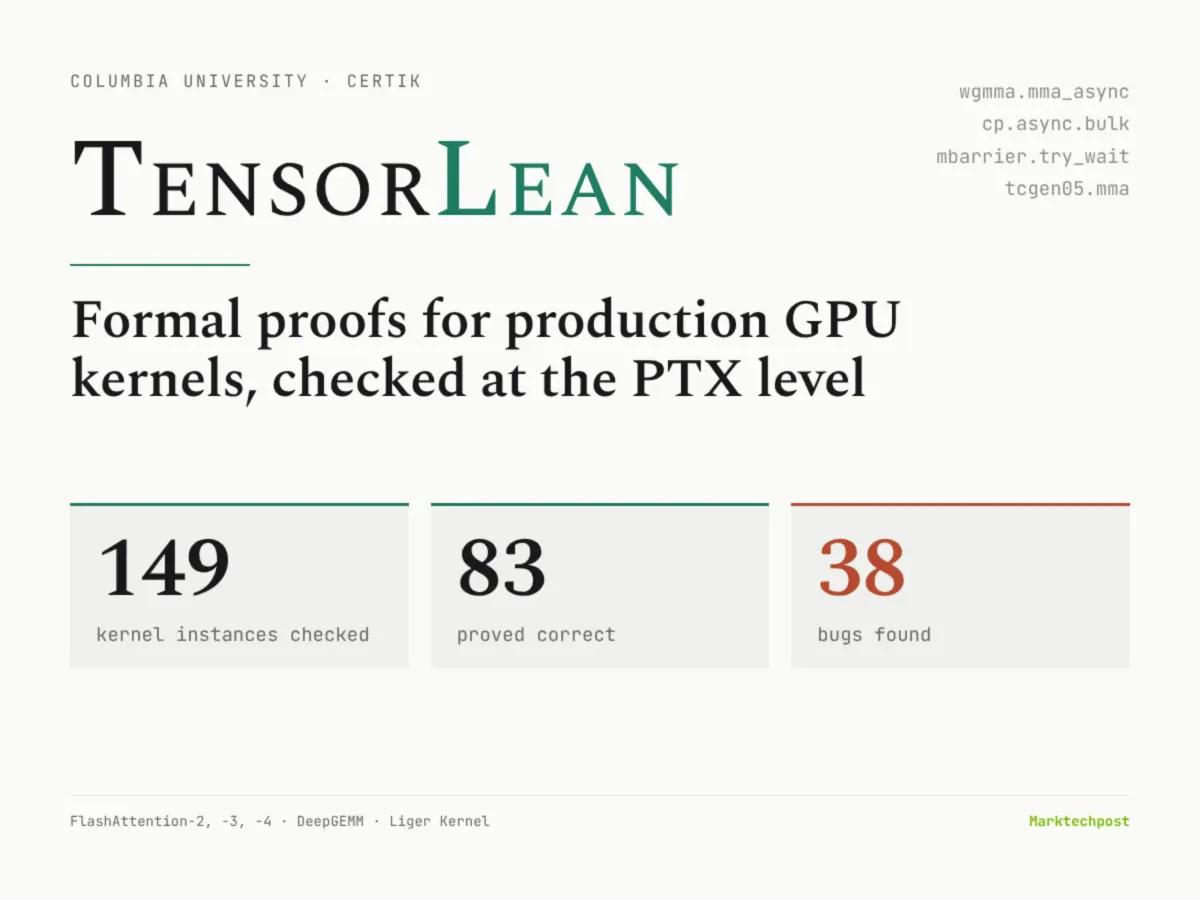
TensorLean finds 38 bugs in GPU kernels
MarkTechPost: A Team of Researchers from Columbia and CertiK Introduce TensorLean for Formal Verification of GPU Kernels
Researchers from Columbia University and CertiK have introduced TensorLean, a framework for formal verification of GPU kernels at the PTX level. TensorLean is a Lean-based verifier that proves compiled kernels match a tensor-level math spec. The research team checked 149 kernel instances, including every kernel of FlashAttention-2, -3 and -4 plus DeepGEMM. It proved 83 correct. The remaining 66 led to 38 correctness bugs. TL;DR Size: 1.8K-line PTX parser. Specs total 10,278 lines agains
TensorLean is a formal verification framework that checks whether GPU kernels (specialized code that runs on graphics processors) work correctly by analyzing them at the PTX level and comparing them against mathematical specifications written in Lean. The framework matters because it found 38 bugs across GPU kernel projects, including data races and numerical errors that conventional testing missed, such as a data race in one kernel that never appeared across tens of thousands of test runs. Formal verification provides mathematical proof that code behaves correctly rather than relying on testing alone, which is valuable for performance-critical GPU code where errors are costly.
- Architect Labs Unveils Frostbite, an Interaction Net CPU Designed by AI · MarkTechPost
- Meta TLX Brings Warp-Group GPU Control to Triton on Hopper, Blackwell, AMD · MarkTechPost
- Inference now drives two-thirds of AI workloads, changing where chips get deployed · SiliconANGLE
- All of today’s AI news, biggest first →
One short email a day with the stories that matter. Free. Unsubscribe with one click.
Want to go deeper than the news? Explore live, cohort-based AI courses taught by practitioners.
Browse AI courses on Maven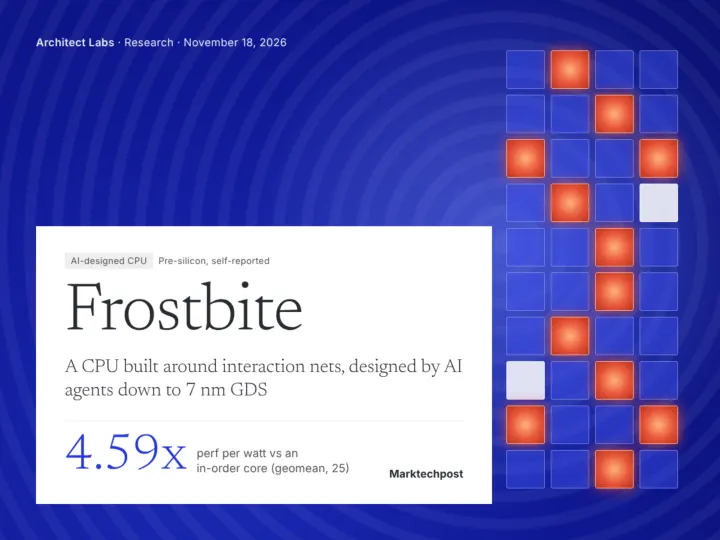
Architect Labs Unveils Frostbite, an Interaction Net CPU Designed by AI
Architect Labs has introduced Frostbite, an AI-designed CPU with a new instruction set built around interaction nets. The company states that its AI agents designed Frostbite from interaction net theory down to final GDS. In pre-silicon tests, it reports 4.59x the performance per watt of a modern in-order CPU core. TL;DR Size: 1 quad (2×2 tiles) plus 4 L3 nodes takes 0.792 mm² on 7 nm. No parameter count (it is a CPU). Runs on: Pre-silicon only. Final GDS closes at 500 MHz on 7
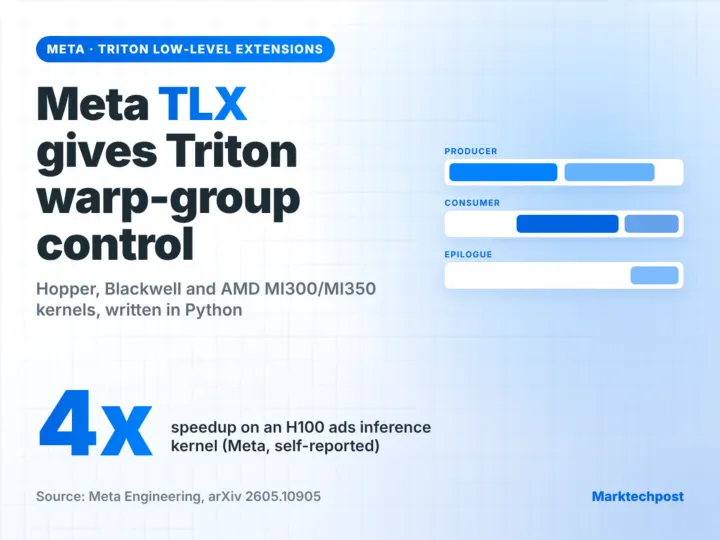
Meta TLX Brings Warp-Group GPU Control to Triton on Hopper, Blackwell, AMD
Meta has published a detailed report on TLX (Triton Low-Level Extensions). It is the GPU compiler extension behind Meta’s production ML kernels. Meta TLX is a Triton extension that exposes warp groups, barriers, TMA and clusters to Python kernels. It targets NVIDIA Hopper and Blackwell plus AMD MI300 and MI350-series GPUs. For kernel engineers, the message is CUDA-level control without leaving Triton. TL;DR What it is: an extension to Triton, not a new language. A Blackwell GEMM ta

Inference now drives two-thirds of AI workloads, changing where chips get deployed
AI spending is shifting from giant training clusters toward smaller, quickly built sites, and modular data centers are becoming a natural home for inference workloads. Power, cooling and memory supply now shape where tokens get generated as much as raw chip performance does. Inference-first chipmakers want to capture that shift. Positron AI Inc., which raised […] The post Inference now drives two-thirds of AI workloads, changing where chips get deployed appeared first on SiliconANGLE.

AI deals shrink to as little as 30 days as the data layer sets the pace
Artificial intelligence has turned data infrastructure from a back-office purchase into the bottleneck that decides how fast GPUs pay off. As hyperscalers, neoclouds and enterprises race to expand their data layers, the way that infrastructure gets bought is changing just as fast. The storage industry’s longtime performance specialist sees that shift as its opening. DataDirect […] The post AI deals shrink to as little as 30 days as the data layer sets the pace appeared first on Silic

Enterprise AI is pushing cloud infrastructure beyond the GPU
Enterprise adoption of artificial intelligence is creating new requirements for enterprise AI infrastructure. While much of the early AI investment centered on access to powerful GPUs, organizations moving AI applications and agents into production are discovering that accelerators are only one part of the equation. Agentic AI systems need environments where they can execute code, […] The post Enterprise AI is pushing cloud infrastructure beyond the GPU appeared first on SiliconANGLE.
NVIDIA and Microsoft Expand Accelerated Computing From Azure to Windows PCs
NVIDIA and Microsoft are extending their full-stack collaboration to help organizations build, customize and deploy intelligent applications — from next-generation infrastructure on Azure to industrial systems and Windows PCs. At Microsoft Ignite, the companies are expanding access to Azure virtual machines powered by NVIDIA Vera Rubin NVL72 systems, as well as adding customer availability to NVIDIA open models and customization capabilities through Microsoft Foundry, and new options for running