
OpenAI reports three major scientific discoveries
The Verge: OpenAI announces three big science discoveries and a new way to work with academics
Less than a month after its mass release of hundreds of manuscripts that it said contained solutions to long-standing mathematics questions, OpenAI is back with three more "major" discoveries in math, computer science, and physics. What's different this time is the choice to have external experts that OpenAI describes as "shepherds" guiding the results in computer science and physics, while for the math problem it says that they advised it to release the AI output for researche
Get smart on it
OpenAI announced three major scientific discoveries in mathematics, computer science, and physics, continuing work it began less than a month earlier when it released hundreds of manuscripts with solutions to long-standing mathematics questions. This time, OpenAI used a new approach by having external experts serve as "shepherds" to guide and verify the results, particularly for the computer science and physics breakthroughs. The approach reflects advice from a panel of math advisers, though that same panel cautioned against certain practices like giving certain people early access to results, recommending instead that AI labs release output on scholarly repositories with formalized proofs and other supporting information. The three discoveries include a proof of the local smoothing conjecture in mathematics, a refutation of the Exponential Time Hypothesis in computer science, and a mathematical proof related to quantum field theories in physics.
Relevant courses
Want to go deeper than the news? Explore live, cohort-based AI courses taught by practitioners.
Browse AI courses on MavenRelated news

Working with academic communities to build scientific understanding
OpenAI shares model results on the Kakeya conjecture, Exponential Time Hypothesis, and quantum chromodynamics—and how researchers can verify and build on them.
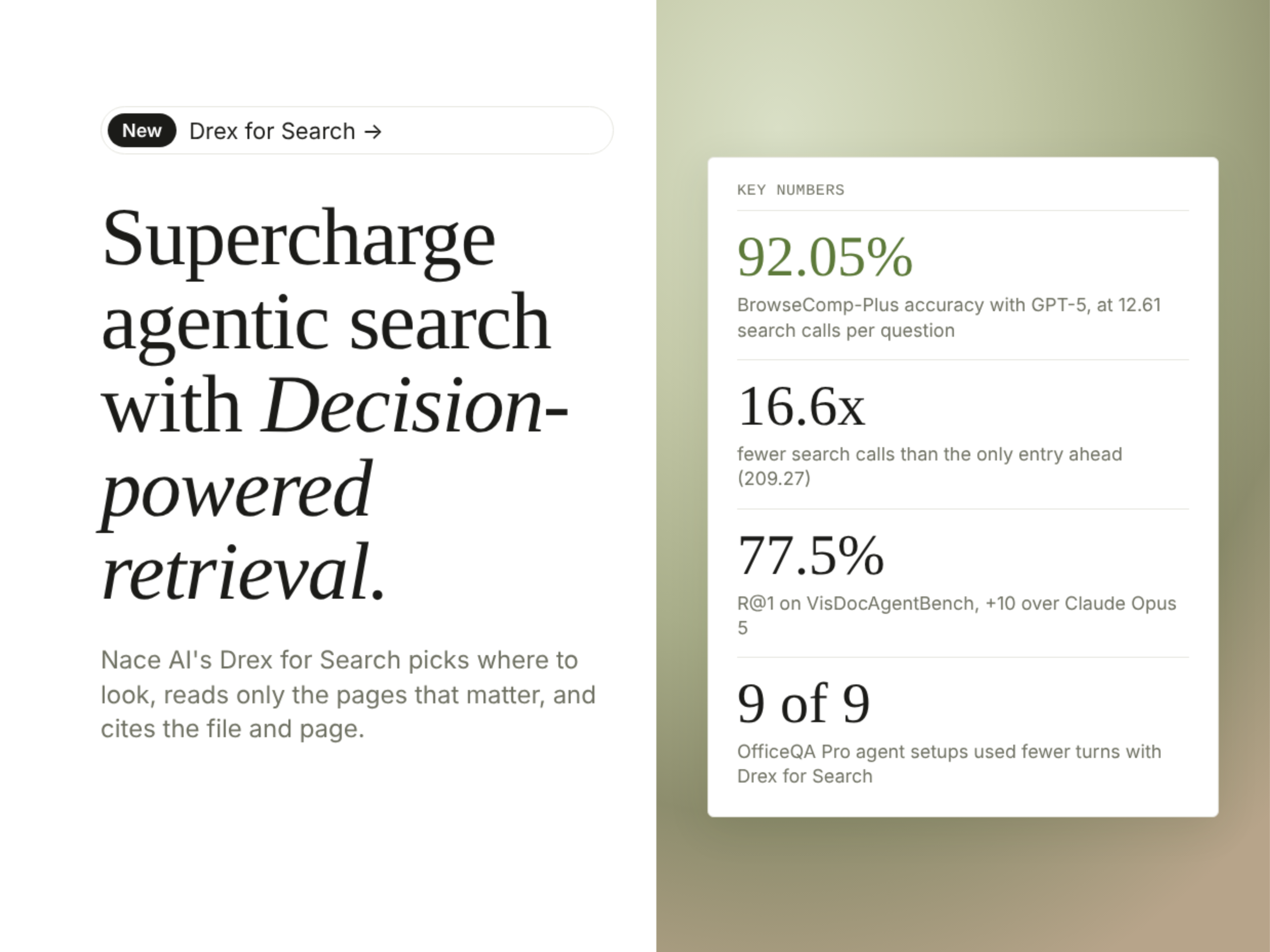
Nace AI Releases Drex for Search for AI Agents: 92.05% on BrowseComp-Plus With 12.6 Search Calls
Nace AI has released Drex for Search, which brings its Drex decision models to document search. Drex for Search is a retrieval layer that helps people and agents find evidence. Coding agents such as Claude Code, Codex, Cursor and OpenCode call it through CLI, SDKs, MCP or REST. In Nace’s evaluation, it scores 92.05% on BrowseComp-Plus with GPT-5, using 12.6 search calls per question. TL;DR Size: a hosted search system built to search over 1M+ files. It pairs with an answering model

Claude Science tackles deadly scorpion stings by designing protein binders from scratch
Anthropic's Claude independently designed protein binders targeting deadly scorpion neurotoxins. Out of more than 318,000 designs, 211 were tested in the lab. Seventeen met the criteria, and the two strongest bind extremely tightly to Cn2, a toxin from a Mexican scorpion. Whether they actually work as antivenom remains an open question. The article Claude Science tackles deadly scorpion stings by designing protein binders from scratch appeared first on The Decoder.
Also reported by The Verge

Microsoft says its AI tool is better than doctors at diagnosing conditions
Microsoft AI chief Mustafa Suleyman. | Getty Images For years, AI leaders have touted healthcare as one of the clearest examples of where their technology will improve lives. Now "it is finally here," Microsoft AI CEO Mustafa Suleyman tells The Verge. The company claims to have developed an AI-powered tool it says can diagnose conditions up to four times more accurately than human doctors. The findings, published Thursday in one of the world's most prestigious journals, Science,

Microsoft’s Mustafa Suleyman says its AI outperforms doctors on hard cases as he chases ‘medical superintelligence’
Microsoft’s new AI diagnostic system beat generalist doctors on hard cases, according to a study in Science. But most of the improvement seems to come from the AI models underneath, not from Microsoft’s system itself.
Inception's Mercury 3 diffusion model claims to beat GPT-6 Luna and Claude Haiku 5.5 at a fraction of the wait
Inception says Mercury 3 is the most capable diffusion language model released so far. The company claims it runs four to eight times faster than GPT-6 Luna and Claude Haiku 5.5 and beats both in eight of 12 benchmarks. There are no independent tests yet. The article Inception's Mercury 3 diffusion model claims to beat GPT-6 Luna and Claude Haiku 5.5 at a fraction of the wait appeared first on The Decoder.