
Liquid AI releases d1.2 omnimodal decision models
MarkTechPost: Liquid AI Releases d1.2 and d1.2-ultra: Omnimodal Decision Models That Top the AA Decision Index
Liquid AI just released d1.2 and d1.2-ultra. A decision model does not write text. It returns calibrated probabilities over a fixed set of answers. The Liquid AI d1.2 decision model family now accepts text, images and audio. It also adds 5 new answer types. d1.2-ultra scores 75 on the Artificial Analysis Decision Index v2.1, the top score among decision models on the index. You can check the deployment options and specs here through our GPULeaderboard.com chrome extension. TL;DR Size: Pa
Decision models are AI systems that return calibrated probabilities over a fixed set of answers rather than generating text, allowing organizations to route low-confidence cases to humans. New omnimodal decision models now accept text, images, and audio inputs while supporting five new answer types including value extraction, span finding, object location, number estimation with ranges, and multi-label selection. The top-scoring model on the Artificial Analysis Decision Index v2.1 achieved a calibration error of 0.8 points across thousands of questions, meaning its confidence levels closely matched actual accuracy rates. These models are priced by input tokens only, with no output token charges, making them cost-effective for decision-making tasks in enterprise applications.
- MLPerf Training v6.1: Bigger Clusters, Broader Hardware, and the Rise of Software-Driven Gains · MLCommons
- MLCommons Releases MLPerf Training v6.1 Results, Spotlighting Recent Advances in AI Training · MLCommons
- Google releases Gemini 4 Hydrogen, a lower-cost model said to outscore Argon · SiliconANGLE
- All of today’s AI news, biggest first →
One short email a day with the stories that matter. Free. Unsubscribe with one click.
Want to go deeper than the news? Explore live, cohort-based AI courses taught by practitioners.
Browse AI courses on Maven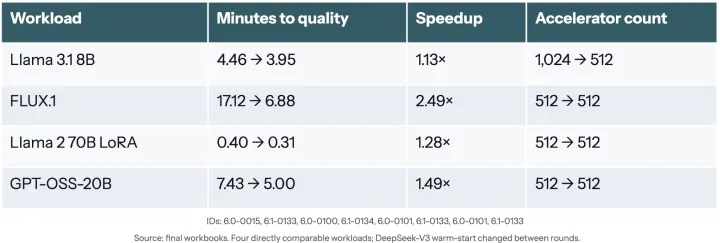
MLPerf Training v6.1: Bigger Clusters, Broader Hardware, and the Rise of Software-Driven Gains
The round at a glance MLPerf® Training v6.1 expands the benchmark suite and features even larger systems from our members. Two benchmarks join the suite: Qwen3.5-397B GRPO for agentic reinforcement learning, and DLRMv4-HSTU, a generative recommender. Google’s Ironwood and NVIDIA’s Rubin make their debut as Available systems. The largest jobs reached 10,240 GPUs (NVIDIA on GB300 and Azure on GB200, both training DeepSeek-V3) [1, 2], multi-node systems rose to 76% of the total, and the hardwar
MLCommons Releases MLPerf Training v6.1 Results, Spotlighting Recent Advances in AI Training
Today, MLCommons® announced new results for the MLPerf® Training v6.1 benchmark suite. The two new benchmarks added in this round, and the submissions received, demonstrate the impact of recent architectural advances in AI training systems and the increasing diversity of the hardware used to train them. “We’ve reached an exciting new threshold for the MLPerf Training benchmark suite, with a higher level of participation in this round, the representation of both established and emerging hardw
Also reported by NVIDIA Blog

Google releases Gemini 4 Hydrogen, a lower-cost model said to outscore Argon
Google LLC today released Gemini 4 Hydrogen, a lower-cost model in its Gemini 4 artificial intelligence family said to outscore Google’s frontier Gemini 4 Argon model on an independent intelligence ranking. Measured on the Artificial Analysis Intelligence Index at its default high thinking level, Hydrogen scored 51 to Argon’s 50, according to Google. A fourth […] The post Google releases Gemini 4 Hydrogen, a lower-cost model said to outscore Argon appeared first on SiliconANGLE
Also reported by MarkTechPost and The Decoder

How good are Fable 5.2 and GPT-6.2 Astra at real work?
We tested Fable 5.2, GPT-6.2 Astra, and four other models on real Epoch work tasks. None met our employee standard, including the two that top our ECI.

Astra for Law leads in legal intelligence
Astra for Law ranked first in a launch evaluation spanning 24 areas of law. Every ChatGPT Enterprise customer can now request access.

A step toward defining the Standard Model on a lattice
Explore a candidate nonperturbative lattice definition of the Standard Model and how GPT-6 Astra helped turn the idea into a detailed proof.