
Cognigy releases AI agent software focused on production reliability
SiliconANGLE: NiCE’s next-generation Cognigy bets the hard part of AI agents is running them, not building them
The contact center has been the low-hanging fruit for the artificial intelligence industry. Ask any information technology or business leader what they want to use agentic AI for, and they will say it’s to improve the customer experience, which starts with the contact center. However, to date, the industry has spent the past two years […] The post NiCE’s next-generation Cognigy bets the hard part of AI agents is running them, not building them appeared first on SiliconANGLE.
A company released a new version of its AI agent software designed for contact centers. The release prioritizes making AI agents reliable and dependable in production environments rather than focusing on raw model intelligence, since AI model capabilities are rapidly improving and becoming cheaper. The software includes features for testing agents, tracing their decisions step-by-step, and supporting both hybrid approaches that combine traditional workflows with AI agents and fully autonomous agent deployments. The broader context is that enterprises are still early in adopting agentic AI and most are not yet ready to hand over entire customer journeys to fully autonomous agents.
One short email a day with the stories that matter. Free. Unsubscribe with one click.
Want to go deeper than the news? Explore live, cohort-based AI courses taught by practitioners.
Browse AI courses on Maven
AT&T uses agentic AI to reinvent business processes from the ground up
AT&T Corp. is moving beyond using artificial intelligence to improve employee productivity, increasingly applying autonomous agents to redesign how its business operates. Nearly 500 agentic workflows are already in production, and the telecom giant plans to triple that number next year. AT&T now processes about 45 billion AI tokens daily across the company, according to […] The post AT&T uses agentic AI to reinvent business processes from the ground up appeared first on Silicon

Introducing ChatGPT Wallet
Introducing ChatGPT Wallet, a secure way for agents in ChatGPT Work, Codex, and dots to complete purchases with user approval and existing card protections.
Also reported by TechCrunch and The Verge

FAA expands AI advice to manage air traffic congestion across entire US airspace
The US government has expanded the use of an AI tool for advising air traffic controllers to assist in managing air traffic across the entire national airspace system. Airline executives have voiced support for the rollout, but the US labor union representing air traffic controllers has said it was not involved in designing or testing the AI-driven system. The Federal Aviation Administration (FAA) says the $875 million SMART system has helped reroute 180 flights since being implemented in airspa
Also reported by Wired AI

OpenAI’s quarterly revenue reportedly crosses $10B for the first time
Sales of $10B represents an almost 50% jump from revenue of $6.7 billion the company recorded in the second quarter.
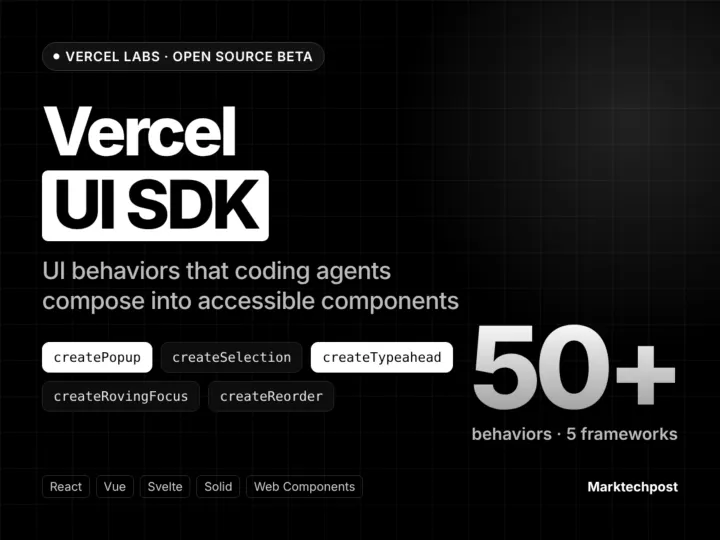
Vercel Releases UI SDK: 50+ UI Behaviors for AI Coding Agents
Vercel Labs has released UI SDK, an open-source beta library of interface behaviors built for coding agents. Vercel UI SDK is a headless library that ships behaviors, not finished components. Agents combine those behaviors into accessible components for React, Vue, Svelte, Solid and Web Components. You can check the deployment options and specs here through our GPULeaderboard.com chrome extension. TL;DR Size: 50+ behaviors, 51 component modules in the repo, 6 npm packages at 0.1.0-beta.1

Amazon has a plan to index the world’s online shopping data
Amazon has plans to build a vault of data on every product sold anywhere on the internet, even products Amazon doesn't sell, and make the information available through its own site, according to Reuters. The project, called the "World Product Graph," is meant to make it less likely that shoppers leave Amazon to do their product research on Reddit or Google, and make it more likely shoppers end up at Amazon even if they're searching for a product sold elsewhere. The same goes fo