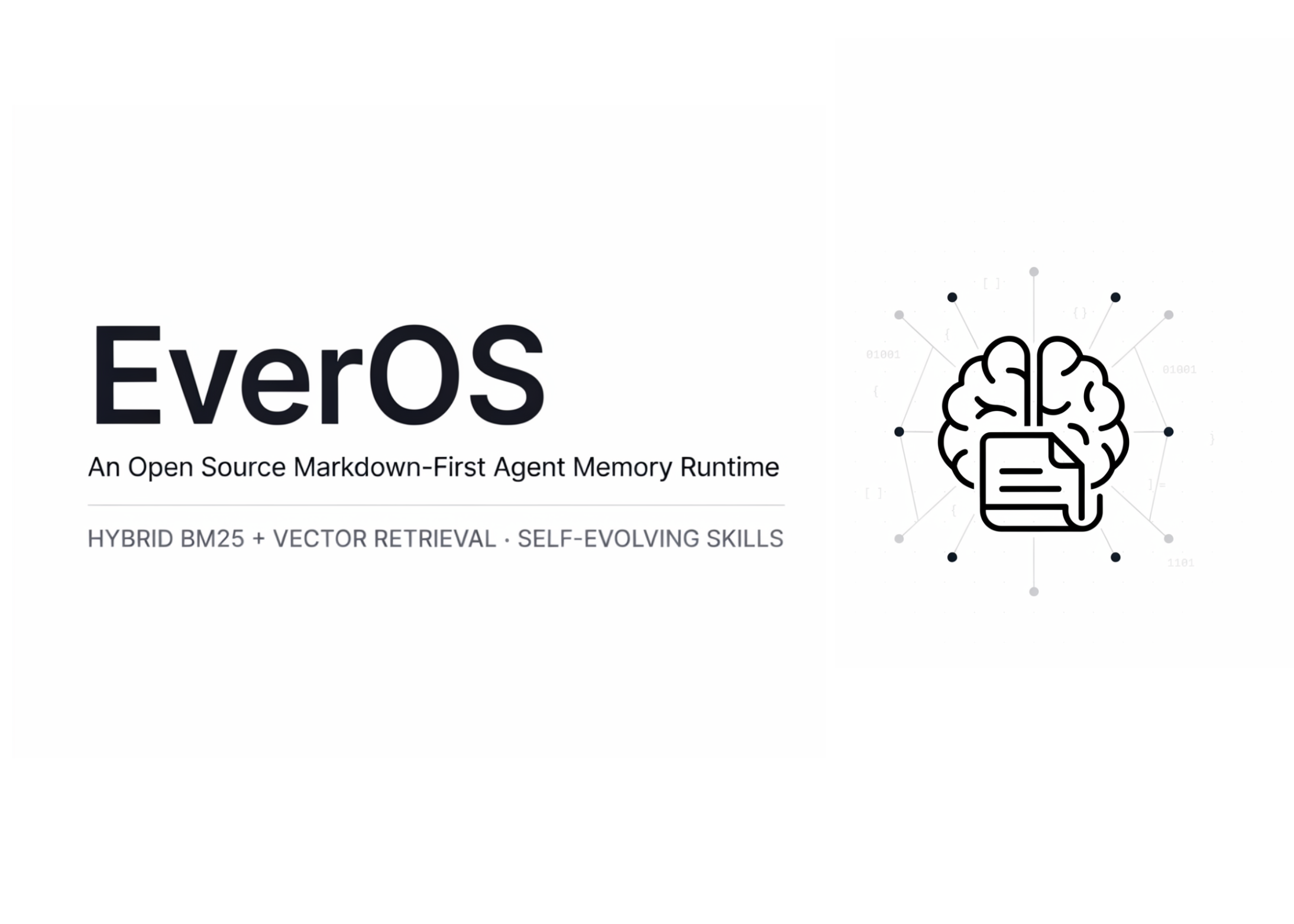
Meet EverOS: An Open Source Markdown-First Agent Memory Runtime With Hybrid BM25 + Vector Retrieval and Self-Evolving Skills
EverMind has released EverOS, an open-source memory runtime for AI agents. It ships under an Apache 2.0 license. It targets a problem agent builders hit early: large language models are stateless. The conversation ends, and the context is gone. EverOS proposes a different substrate. Instead of locking memory inside a vector database, it writes memory as plain Markdown files. Those files become the source of truth that agents read, edit, and search across sessions. TL;DR EverOS stores
Get smart on it
EverOS is an open-source memory system for AI agents that stores information as editable Markdown files instead of locking it inside databases. Large language models are stateless, meaning conversations and context disappear after each session, and EverOS addresses this problem by maintaining persistent memory across interactions that agents can read, edit, and search. The system uses a hybrid retrieval approach combining keyword matching, vector search, and filtering in single queries, and it introduces procedural memory where repeated successful task patterns are automatically converted into reusable skills that improve agent performance over time. EverOS runs locally by default with no required external services, keeping data inspectable and under user control, though a cloud option is available for teams that prefer managed hosting.
Related news

Suno launches Spark incubator program to feed independent artists to its AI machine
Suno has ambitions to be more than just a toy to churn out AI slop, it also wants to be a streaming destination and to break new artists. Spark is their new incubator program for independent artists that provides grants, mentorship, and marketing support. To apply, artists need to be an unsigned singer, songwriter, or producer releasing music under their own name. They also need to agree to some terms and conditions that have raised some eyebrows over on the Suno subreddit. For

OCRmyPDF Tutorial: Convert Scanned Documents into Searchable PDF/A Files with Sidecar Text Extraction and Batch Processing
In this tutorial, we build an advanced, self-contained OCRmyPDF workflow. We start by installing the required system and Python dependencies, then create a synthetic image-only PDF for scanning so we can test OCR without relying on external files. From there, we use OCRmyPDF’s real public API to convert scanned documents into searchable PDFs, generate PDF/A outputs, extract sidecar text, validate the results, compare file sizes, tune Tesseract settings, clean noisy scans, handle already-OCRed f