
Health Care Workers Are Tired of Cleaning Up Palantir’s Mess
A hospital giant and radiology network turned to Palantir to streamline scheduling, but nurses and other staff say the new software is causing errors, burnout, and frustration.
A hospital chain and a radiology network have implemented AI scheduling software built by a data analytics company to automate shift assignments for nurses and medical staff. Health care workers report that the software frequently ignores their scheduling preferences, assigns them to back-to-back shifts, schedules too few experienced nurses during certain periods, and requires more time spent trading or appealing schedules than the previous manual system. The workers allege these scheduling errors have caused exhaustion and understaffing that may harm patient care, while the company maintains that human leaders make final scheduling decisions and that the tool is designed to balance staffing needs with employee preferences. A former data science manager has sued the hospital chain, alleging it deleted data used by the software in ways that may have prevented proper auditing and violated healthcare laws.
One short email a day with the stories that matter. Free. Unsubscribe with one click.
Want to go deeper than the news? Explore live, cohort-based AI courses taught by practitioners.
Browse AI courses on Maven
At Holiday Extras, dots get to work before anyone asks
Dots deliver launch reports unprompted, flag issues people might miss, and talk through upcoming meetings on the commute to work.

OpenAI wants to stop deepfakes from overwhelming child abuse tiplines
OpenAI is announcing a tool that it says will help child sexual abuse investigators cut through the noise to find harmful material they can act on quickly. At a Monday press briefing in Washington, DC, OpenAI announced a classifier it says can better detect abusive imagery of kids, including whether it's AI-generated. It's also offering free access to vetted organizations, giving developers more guidance on how to detect this type of content, and helping to train law enforcemen

Advancing computer-use agents for healthcare teams
Automating routine clinical tasks could free physicians and nurses to focus on patient care and complex decision-making.

More ways to move care forward with ChatGPT for Healthcare
Introducing computer-use agents, improved clinical answers, and new healthcare plugins that work across healthcare software to get real work done.
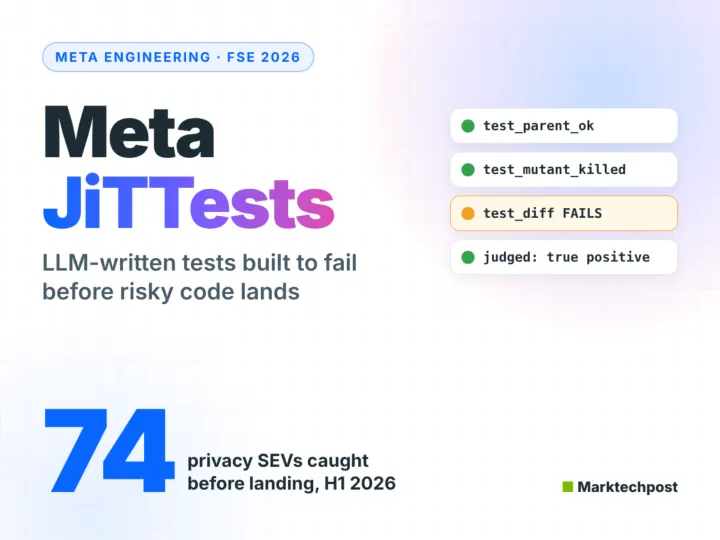
Meet Meta’s JiTTests: LLM-Generated Tests Designed to Fail Before Risky Code Lands
Meta has moved Catching Just-in-Time Tests (JiTTests) from research prototype into its production infrastructure. Meta JiTTests is an LLM-based system that writes executable tests designed to fail on a risky code change. A failing test is concrete evidence that a diff changed behavior. Meta team reports that JiTTests caught 74 privacy SEVs at the diff stage in the first half of 2026. The method is described in the FSE 2026 research paper ‘Just-in-Time Catching Test Generation at Meta̵

LVMH’s Media Division announces strategic partnership with OpenAI
LVMH’s Media Division and OpenAI announce a partnership to support journalism with AI and make its publications more accessible through ChatGPT.