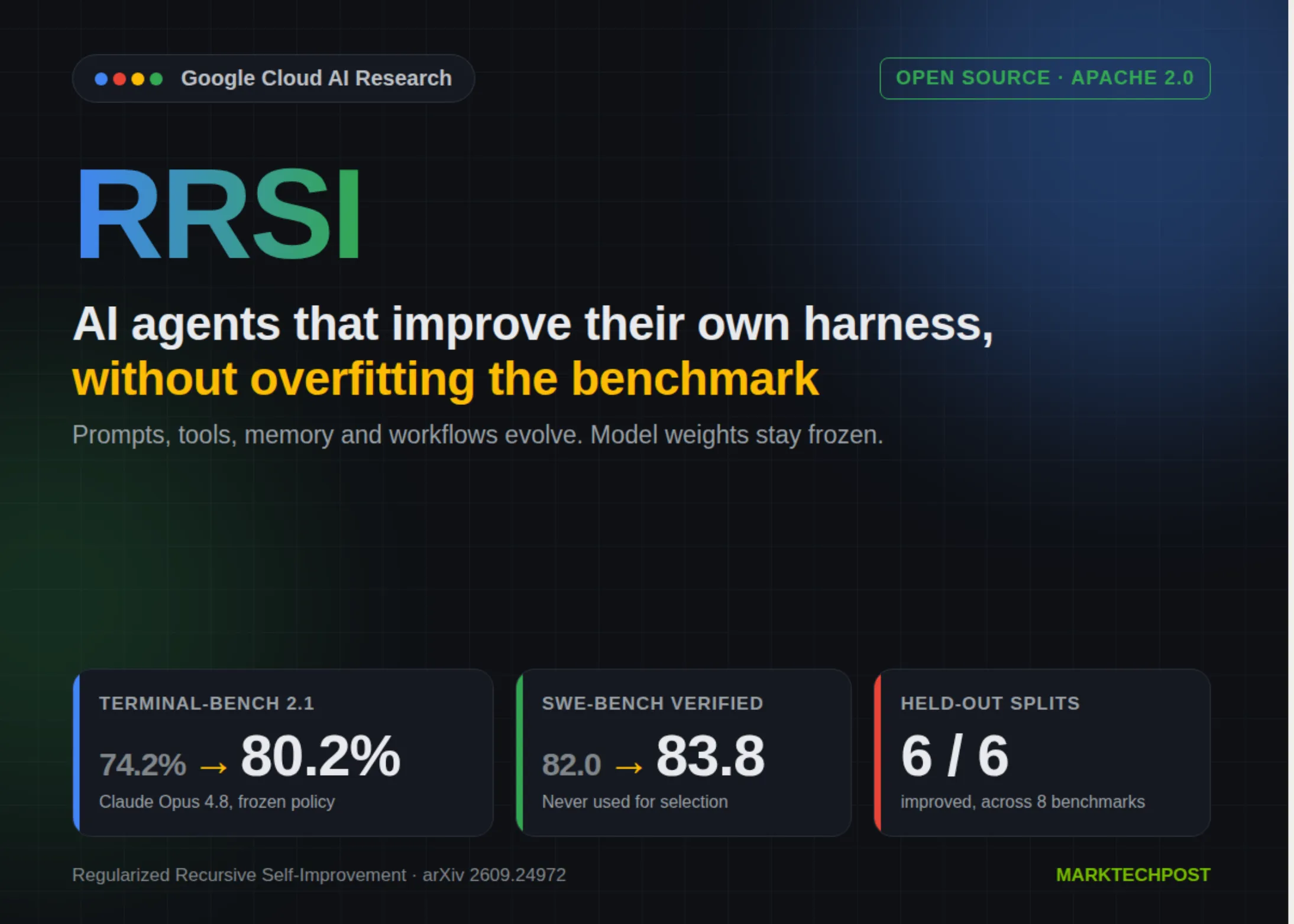
Google Research Open-Sources RRSI: AI Agents That Improve Their Own Harness Without Overfitting
Google Cloud AI Research, with UNC-Chapel Hill, Stanford and Washington University in St. Louis, has released RRSI (Regularized Recursive Self-Improvement). It lets an LLM agent rewrite its own harness: prompts, tools, memory, control flow and sub-agents. Model weights never change. RRSI constrains the improvement loop itself, so gains hold on benchmarks the agent never optimized against. Deployable? Yes, as a research framework. The code is Apache 2.0, needs Python 3.10+, and accepts any Li
Get smart on it
RRSI is an open-source research framework that allows AI language model agents to automatically improve their own operational components, including prompts, tools, memory, and control flow, without changing the underlying model weights. The system addresses the problem of overfitting by constraining the improvement process through multiple regularization techniques: an edit budget that decreases over time, a screening step that rejects task-specific logic, a noise-adjusted floor that requires genuine performance gains, a cost rule that charges for extra inference tokens, and pruning of underperforming components. Testing across eight benchmarks showed improvements ranging from 1.1 to 4.9 points on held-out test sets that the system never optimized against, demonstrating that gains transfer beyond the tasks used for training. The code is available as Apache 2.0 licensed software requiring Python 3.10 and compatible with various language models through LiteLLM.
Related news
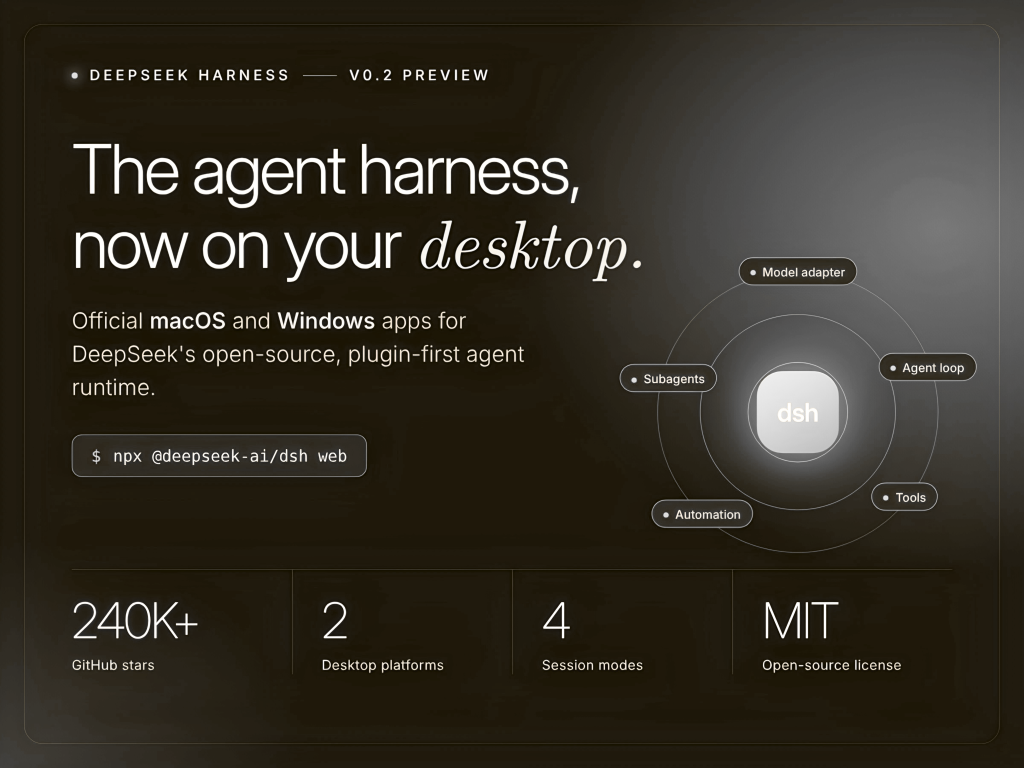
DeepSeek Harness v0.2 Brings Official Desktop Apps to Its Open-Source Agent Harness
DeepSeek has released an official desktop app for DeepSeek Harness (dsh), its open-source agent harness. The app ships with the v0.2 preview. Installers cover macOS (Apple silicon) and Windows (64-bit). Is it deployable? Yes, today, as a preview. Download it from deepseek.com/harness or run npx @deepseek-ai/dsh web. DeepSeek warns that compatibility-breaking changes will follow. What Shipped in v0.2 A harness is the runtime that turns a model into an agent. It reads files, runs command
The Agent Said It Was Done. The Database Disagreed.
When AI systems claim task completion without verification, downstream errors can cascade through dependent processes, exposing gaps in reliability for critical workflows.