
Claude’s Duet agent is a little neurotic and surprisingly helpful
Let’s get to work. | Photo: Allison Johnson / The Verge Normally, the products I test don't offer to help me write up my experience with them. Duet is different. Claude Duet is Anthropic's AI agent for consumers, the latest attempt by an AI company to try to convince us that agents can be useful for people who don't write code. It's been an interesting couple of months: Instinct gave us an impressive text-based assistant, Meta offered us its cute little guy, Muse, to help us buy
Claude Duet is an AI agent designed by Anthropic to help professionals and small business owners manage their work by integrating with email, calendars, messaging apps, and shared documents. The agent proactively suggests tasks and drafts messages by synthesizing information across these multiple sources, functioning as a kind of digital assistant. In testing, the agent proved helpful at catching overlooked details and coordinating work across platforms, but sometimes made poor judgments about urgency and tone, behaving overly anxious about minor deadlines. The experience highlights both the potential for AI to backstop organizational systems and the current limitations in AI's ability to understand nuance and communicate tactfully.
One short email a day with the stories that matter. Free. Unsubscribe with one click.
Want to go deeper than the news? Explore live, cohort-based AI courses taught by practitioners.
Browse AI courses on Maven
Claude Meetings lets Anthropic's AI join your video calls
Anthropic is adding Claude directly to video calls. Claude Meetings joins Google Meet sessions and creates documents, whiteboards, and meeting notes in real time. The feature launches in beta for Team and Enterprise plans, with more platforms coming later. The article Claude Meetings lets Anthropic's AI join your video calls appeared first on The Decoder.

OpenAI’s quarterly revenue reportedly crosses $10B for the first time
Sales of $10B represents an almost 50% jump from revenue of $6.7 billion the company recorded in the second quarter.

FAA expands AI advice to manage air traffic congestion across entire US airspace
The US government has expanded the use of an AI tool for advising air traffic controllers to assist in managing air traffic across the entire national airspace system. Airline executives have voiced support for the rollout, but the US labor union representing air traffic controllers has said it was not involved in designing or testing the AI-driven system. The Federal Aviation Administration (FAA) says the $875 million SMART system has helped reroute 180 flights since being implemented in airspa
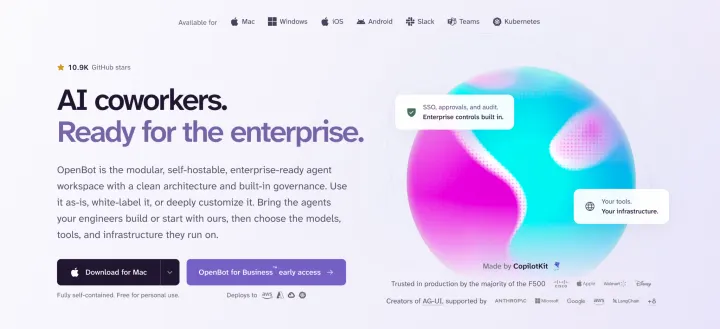
CopilotKit Releases OpenBot 1.0: An MIT-Licensed, Self-Hostable AI Coworker With Built-In Governance
Most AI coworker products are vendor locked. They pick the model, host the data, and write the rules. CopilotKit is taking the opposite route. OpenBot 1.0, was released November 9th, an MIT-licensed, self-hostable agent workspace. What sets it apart is, a company brings their own models, agents and infrastructure. Governance is fully baked in, and every Bot action is checked against a policy before it runs. What is OpenBot? OpenBot is a modular agent workspace from CopilotKit, the team be

Kubernetes gets a second act as AI agents turn one prompt into thousands of inference calls
The rise of agentic AI systems is giving Kubernetes, long valued for its reliability and predictability, an unexpected second act. As AI spending shifts from training models toward serving them and running agents, the open-source community is developing tools to handle the growing volume of inference requests. The orchestration platform was built from the start […] The post Kubernetes gets a second act as AI agents turn one prompt into thousands of inference calls appeared first on Silicon

Google retools Kubernetes for AI agents instead of building a new stack
Agentic workloads are pushing Kubernetes into territory its creators never planned for. Agents generate untrusted code on the fly, sit idle for long stretches and churn through pods at a pace that strains the orchestrator’s control plane. Cloud providers are now rethinking how general-purpose a cluster should be. Google LLC’s answer is to stop treating […] The post Google retools Kubernetes for AI agents instead of building a new stack appeared first on SiliconANGLE.